



Anodized vs Powder-Coated Aluminum: Which Finish Holds Up
Anodized or powder-coated? Film thickness, colour range, heat and slot tolerance decide it — and the coastal answer depends on sealing, not on the process name.
Neither finish is better in general. Anodizing converts the surface into a 15–25 µm oxide layer that cannot peel, holds a hard metallic look, and barely changes the dimensions. Powder coating lays down a 60–120 µm cured film in any RAL color, and swallows minor extrusion marks. The decision is film thickness against color range. Add one number most comparisons leave out: what the coating does to a 2 mm-wide diffuser slot.
What each process is
The two are not competing versions of one thing. One modifies the metal. The other sits on top of it.
Anodizing is electrochemical. The aluminum becomes the anode in an acid bath, and its surface converts into aluminum oxide. That layer is hard, porous, and structurally part of the metal. The pores are then sealed, usually in hot water or a nickel-fluoride bath. That sealing step decides whether the finish survives outdoors.
Powder coating is electrostatic deposition. A dry resin powder is sprayed onto a grounded profile. Heat then cures it at roughly 180–200 °C, so the powder melts, flows and cross-links into a continuous film. There is no chemical bond to the metal, so adhesion depends on pretreatment. The film is also thick enough to matter dimensionally.
| Property | Anodized | Powder-coated |
|---|---|---|
| Film thickness | ~15–25 µm (typical) | ~60–120 µm (typical) |
| Bond to metal | Conversion of the surface itself | Adhesion after pretreatment |
| Scratch and wear | High. Hard oxide, cannot peel | Moderate. Chips at an impact point |
| Color range | Silver, black, bronze, champagne | Any RAL |
| Effect on dimensions | Negligible | Adds film thickness on all faces |
| Thermal path | Essentially unchanged | Reduced, because the resin insulates |
| Typical outdoor life | 15–20 years when sealed | 5–8 years, UV-dependent |
The numbers above are typical published values across the finishing industry, not measurements from our line. They shift with alloy, bath chemistry and powder grade, so treat them as a ranking.
The coastal disagreement
Search this topic and you find two confident, opposite answers.
One group says anodizing is the coastal choice: harder, non-peeling, salt-spray tested, 15–20 years.
Another says anodizing fails faster at the coast, with pitting within 12–18 months inside 5 km of the shoreline. The oxide layer is porous, chloride ions attack it, and a thick powder film is a continuous barrier.
Both describe real failures, and neither is wrong about the mechanism. The variable they omit is sealing and film thickness.
An unsealed or thinly sealed anodic layer is a sponge. Sealed to spec, it is a hard barrier that performs for decades. That means the oxide fully hydrated or nickel-fluoride sealed, at the upper end of the thickness range. A powder coat applied over poor pretreatment will delaminate from the inside out, however thick it is.
So the useful question is not which process. It is this: what film thickness and what sealing does this supplier specify, and does it match the exposure?
If a quote says "anodized" with no thickness, it is not a specification. Ask for the micron figure and the sealing method, the same way you would ask for a wall thickness.
Where powder coating breaks the fit
This is the part that catches people on site, and it does not appear in finish comparisons.
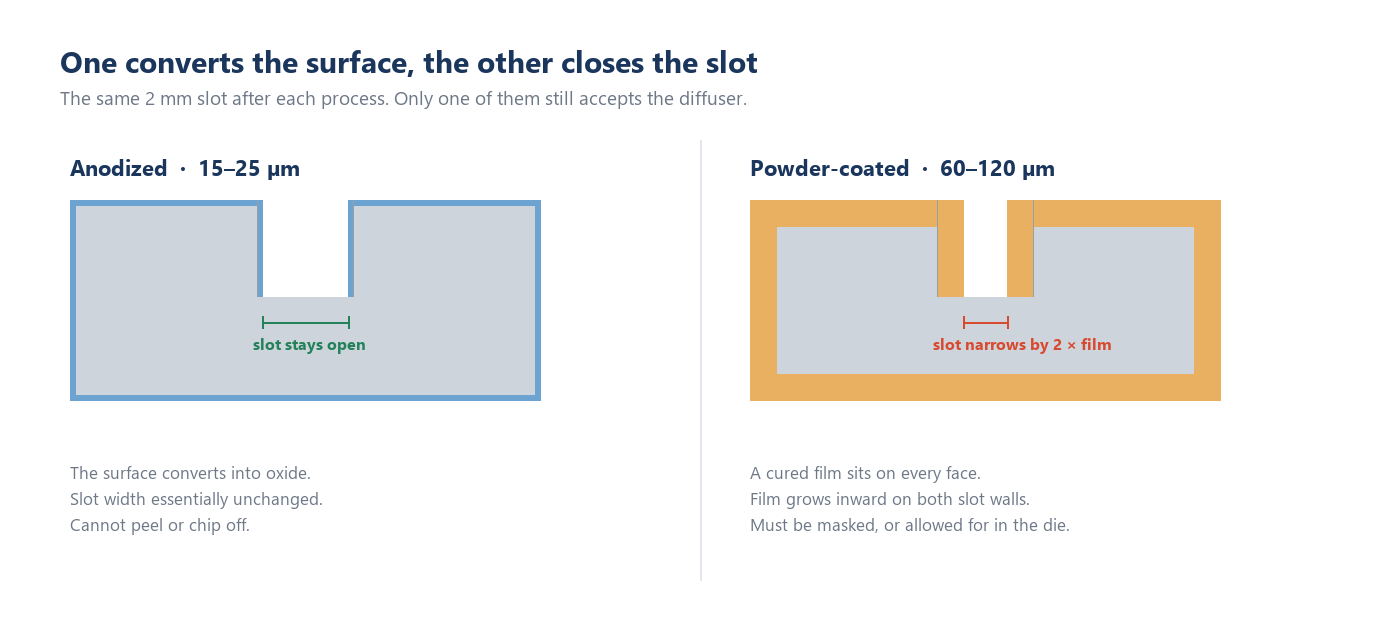
A powder film adds 60–120 µm on every face, including the inside of the diffuser groove and the end-cap recess. Two consequences follow.
- The diffuser groove narrows. A groove drawn with 0.2 mm clearance per side can end up tight, and a press-in cover will not seat.
- End caps and connectors no longer fit flush. The cap is sized to the extrusion, not to the extrusion plus film.
Experienced extruders mask critical faces before coating, or allow extra clearance in the die design. Not all do, and the failure shows up at assembly, not in the sample.
Take a narrow section, such as a 10 mm body with a 6 mm strip. There the groove is a small fraction of the profile and the film is a large fraction of the clearance. On tight sections, anodizing is the lower-risk finish, because it does not change the geometry.
Where powder coating is the only answer
Two cases leave no real choice.
Trimless bodies. A trimless profile is filled and painted with the plaster, so it has to take the wall color. Anodizing gives silver, black, bronze or champagne. None of those matches a painted wall. Powder coat in the specified RAL does, and it is the only way the line reads as a shadow gap instead of a metal strip.
Color-matched joinery. When the profile has to sit inside a lacquered cabinet or a specific ceiling color, the color range decides. Anodizing cannot match it.
There is a third, softer case: hiding extrusion marks. A powder film covers die lines and minor surface variation that anodizing exposes. On a long visible run, that difference shows.
What we quote, and why it matters
Our specification sheet lists the finish as "Anodized / Painting" on 214 of 219 profiles, with 5 listed as anodized only. That slash is deliberate. It means the finish is specified per order, not defaulted.
That phrasing has a practical consequence for buyers.
- If you need a color match, say so at inquiry and give the RAL. The profile will be powder-coated.
- If you need coating-free geometry, say so and it will be anodized.
- If you say nothing, you get whichever the factory is set up for that week, and it may not be the one your assembly needs.
Coating-free geometry means a tight groove, a sliding fit, or a snap-in cover on a small section.

Ten profiles in the range list black anodized specifically, not the general "anodized / painting". There the black anodized look is the product: a matte black line against dark cabinetry or a shadow gap. Those are specified that way for appearance, not as a corrosion choice.
How to specify it in one line
Write the finish as a three-part requirement, not a single word:
Anodized, 15–20 µm, sealed. Or powder-coated, RAL 9016, matte, 80 µm minimum.
Then add the one sentence that prevents the assembly problem:
Confirm that the diffuser groove and end-cap recess are either masked or sized to accommodate the film.
A supplier who can answer both has thought about the coating as a dimension, not a color.
PERGUNTAS FREQUENTES
Which finish lasts longer outdoors?
Sealed anodizing, typically: 15–20 years against 5–8 for many powder coats in strong UV. But an unsealed anodic layer can pit within a year or two at the coast, so thickness and sealing matter more than the process name.
Does powder coating reduce heat dissipation?
Yes, slightly. The cured resin film insulates the surface it covers. For typical LED strip loads the difference is small. On a high-output strip in a shallow body, it adds to a thermal margin that may already be tight.
Can I get a white anodized profile?
Not a true white. Anodizing tints the oxide layer, which limits the palette to silver, black, bronze and champagne tones. For white, the profile has to be powder-coated.
Will powder coating stop the diffuser from clipping in?
It can, on a tight section. The film adds 60–120 µm per face, which eats the clearance designed into the groove. Either mask the groove before coating, or allow for the film in the die design.
Which finish should I choose for a coastal project?
Neither by name. By specification: sealed anodizing at the upper thickness range, or a powder system with a proven salt-spray result and correct pretreatment. Ask for the micron figure and the test standard, not the finish type.
See also: What a profile does, and the black anodized range.
We design and supply LED aluminum profiles and linear lighting — over 200 profiles with matched diffusers and fittings, serving customers in more than 100 countries since 2007.
Related reading
Send the strip width, the run length and the destination — we will match the profile, the diffuser and the fittings, and quote within 1 business day.
Start your inquiry