



How to Choose a Profile for a Bathroom or Wet Area
Bathrooms fail on condensation and cleaning chemicals, not on splashes. What the zones actually require, and why the profile is never the waterproof part.
Bathrooms are specified as if the risk were splashing. The two failures we see most are condensation on a cold aluminum face and cleaning chemicals attacking the finish — neither of which an IP rating covers. The profile’s job is to hold the strip, spread the light and stay dimensionally stable; the sealing is done at assembly, not at the extrusion.
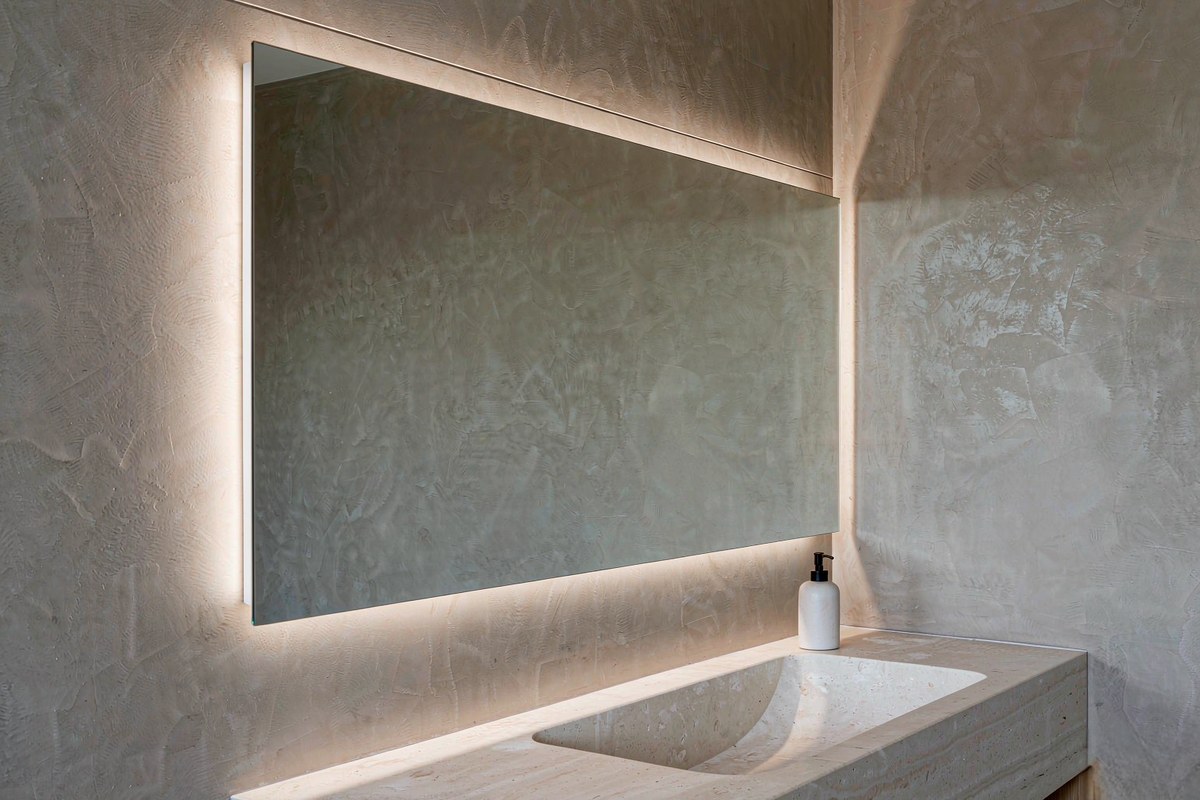
What the zones actually require
The Zone 0 / 1 / 2 system comes from IEC 60364-7-701, an electrical installation standard — not from the IP code. It sets a minimum IP requirement for equipment in each zone; the IP code itself (IEC 60529) only defines what each number means.
| Zona | Where it is | Minimum IP for equipment | Practical note |
|---|---|---|---|
| 0 | Inside the bath or shower tray | IPX7 | Low-voltage only; almost never a linear profile |
| 1 | Above the bath or shower, to 2.25 m | IPX4 (IPX5 in some national codes) | Where a shower niche or ceiling line sits |
| 2 | 0.6 m around zones 0 and 1 | IPX4 | The mirror surround, most vanity lighting |
| Outside zones | The rest of the room | No requirement | Still a humid room — see below |
Two things this table does not say, and both matter:
- The IP number belongs to the assembled fixture, not to the extrusion. A profile rated IP20 becomes part of an IP65 assembly only if the cover, end caps and cable entry are sealed.
- Zone compliance is a minimum, not a target. Most failures in bathrooms are not in Zone 1. They are on a mirror outside the zones, where nobody thought about moisture at all.
The profile is not the waterproof part.
This is the same point that applies outdoors, and it applies more often in bathrooms because the fixture is smaller and the sealing is done by whoever installs it.
An extrusion is an open channel. The diffuser groove is a capillary seam; end caps frequently come with cable holes; a cut end exposes the PCB. Aluminum resists corrosion, but resisting corrosion is not the same as preventing ingress.
What a bathroom-suitable profile actually provides is the geometry to seal: a groove tight enough to hold a bead of neutral-cure silicone, closed end caps for that section, and a provision for a cable gland. Everything else is done on site, and done once — a bathroom fixture is rarely opened again.
We do not claim an IP rating for any aluminum profile. Our published IP68 certificate covers the LED neon range (HL-NT1615V24IP68 and the related NS/NV models, EN 60529) and does not extend to profiles; that scope is stated on the certificates page rather than left to inference.
Two failures the IP rating does not cover
Condensation. A bathroom cycles between 25 °C and 45 °C with near-saturated air, several times a day. Moisture condenses on the coldest surface in the room, which is usually the aluminum. It does not arrive as a splash — it forms on the inside of the diffuser and runs down to the lowest point, which is the end cap.
A sealed chamber makes this worse, not better: the trapped air carries the moisture in, and it has nowhere to leave. Practical measures that work:
- vent the run with a hydrophobic breather, or leave a desiccant sachet in the junction box;
- keep the driver out of the bathroom — in a cabinet, a loft, or an adjacent room;
- avoid a fully potted strip in a small sealed profile; the heat has nowhere to go, and the moisture cannot leave.
Cleaning chemicals. Bathroom cleaners are typically alkaline, and some contain chlorine or quaternary ammonium compounds. An unsealed anodized surface is porous; a powder coat is a polymer film. Both can be attacked, and the damage looks like a dull patch that will not clean off — the finish is gone, not dirty.
Practical rule: specify a sealed anodized finish or a powder coat for anything within reach of a spray bottle, and tell the client which cleaner is safe. This is a finish decision, not an IP decision.
Mirror lighting amplifies every dot.
The mirror is the hardest surface in the bathroom to light well, because it doubles the problem.
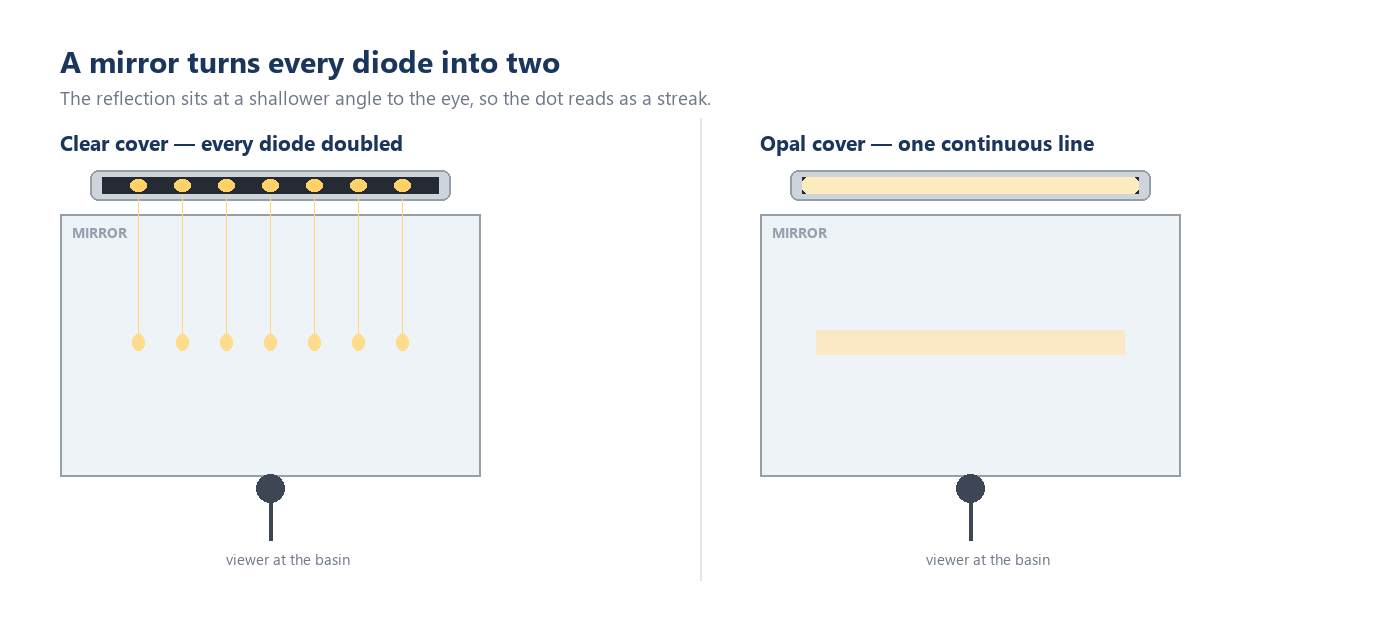
A bright diode seen directly is a point. Seen in a mirror, it is a point plus its reflection, and the reflection is at a shallower angle to the eye — which makes the dot read as a streak. On a 15 mm deep body with a clear cover, that is immediately visible to anyone standing at the basin.
What actually fixes it:
- A diffusing cover — opal or frosted, not clear. This is the single biggest improvement.
- Enough cavity depth — the further the strip sits from the diffuser, the more the points blend. A shallow mirror profile is the worst case for dot visibility.
- Indirect placement — light thrown onto the wall behind or above the mirror, rather than through the mirror face. It removes the reflection problem entirely.
Do not try to solve it with output. More light makes the dots brighter, not softer.
What we have for bathrooms
Four profiles carry a bathroom/mirror application tag, all within the wet-area group of 11 bodies:
| Modelo | Outer W × H | Strip | Mounting | Cover |
|---|---|---|---|---|
| HL-BAPL067-F | 10.3 × 10.3 mm | 8 mm | corner | PMMA |
| HL-BAPL065-F | 11.4 × 12.2 mm | 9 mm | surface | PMMA |
| HL-BAPL066-F | 12.3 × 10 mm | 10 mm | surface | PMMA |
| HL-BAPL069-F | 17 × 14 mm | 11 mm | surface | PC |


All four are small-section — the largest is 17 × 14 mm — because mirror and vanity runs are short and the body has to disappear behind or beside the glass. Three carry a PMMA cover, which is the material that holds clarity best in a humid room; the fourth uses PC where the run is within reach and mechanical protection matters more.

None of them is sold as a waterproof fixture. They are the bodies that can be sealed into one.
A short specification checklist
- Which zone is it in? If it is outside the zones, the IP question is still open — humidity does not stop at a line on the floor plan.
- Is the driver outside the room? This is not optional in practice, and it is the most common installation error.
- Can the section be sealed? Groove that holds a bead, closed caps, gland provision.
- Is the cover diffusing? Especially at a mirror, where a clear cover doubles every diode.
- Is the finish suited to the cleaner? Sealed anodized or a powder coat, and tell the client what to use.

The wet-area bodies are listed under outdoor and waterproof profiles, with the section drawing on each model page. If the room is unusual — a wet room with a floor drain, a steam shower, a pool-adjacent bathroom — send the layout, and we will confirm which sections clear it and where the sealing has to happen.
PERGUNTAS FREQUENTES
What IP rating does bathroom LED lighting need?
It depends on the zone, not on the room. Under IEC 60364-7-701, Zone 1 and Zone 2 require a minimum of IPX4; outside the zones, there is no requirement. In practice, most specifiers use IP65 assemblies near water because the joint, not the rating, is what fails.
Is an aluminum profile waterproof on its own?
No. The extrusion is an open channel with a capillary seam along the diffuser groove and often open end caps. It becomes part of a water-resistant assembly when the cover, caps and cable entry are sealed during installation.
Why does my bathroom strip keep failing at the ends?
Condensation collects at the lowest point of the run, which is usually an end cap. A sealed chamber makes it worse because the moisture cannot leave. Vent the run, keep the driver out of the room, and seal the cut ends properly.
Can I use a clear cover behind a mirror?
You can, but every diode will be visible twice — directly and in the reflection. A diffusing cover and a deeper cavity are what remove the dots; increasing output makes them more obvious.
Will bathroom cleaner damage the profile finish?
It can. Alkaline and chlorine-based cleaners attack both anodized and powder-coated surfaces, and the damage looks like a dull patch rather than dirt. Specify a sealed finish and tell the client which cleaner to use.
Related links
- Outdoor and wet-area profiles — 11 bodies
- Ceiling and cove profiles for bathroom ceilings
- All LED aluminum profiles — section drawing on every model
- Certificates and what each one actually covers
- Send the bathroom layout for a sealing recommendation
See also: IP ratings explained, e HL-A092 — a 6 mm deep body with a silicone cover.

We design and supply LED aluminum profiles and linear lighting — over 200 profiles with matched diffusers and fittings, serving customers in more than 100 countries since 2007.
Engineering Lead · Reviews every dimension, extrusion section and installation step for technical accuracy before publication.
Translation and copy review — terminology, clarity and consistency of the English text.
Related reading
Send the strip width, the run length and the destination — we will match the profile, the diffuser and the fittings, and quote within 1 business day.
Start your inquiry