



Slim vs. Wide Profile: Where Each Belongs
Slim is about presence, wide is about aperture and heat. The figure that decides whether a slim body is usable is not its width — it is the strip inside.
Slim and wide are not two points on a quality scale. They solve different problems: slim is about how much the fixture exists in the room, wide is about how much light leaves it and how much metal carries the heat. The figure that decides whether a slim body is usable is not its width — it is the strip that has to go inside.
What does width actually change?
Four things, and they move in different directions.
| Slim body | Wide body | |
|---|---|---|
| Visual presence | A line, or almost nothing | A visible architectural element |
| Aperture | Narrow — the light line is thin | Wide — the line is a band |
| Heat capacity | Limited by section mass | More metal, more spreading |
| Strip compatibility | Narrow strips only | Wider strips, multi-row possible |
| Mounting depth needed | Shallow | Deeper, or surface-mounted |
The first two are what people mean when they compare slim and wide. The last two determine whether the comparison is even available.
Where does slim win?
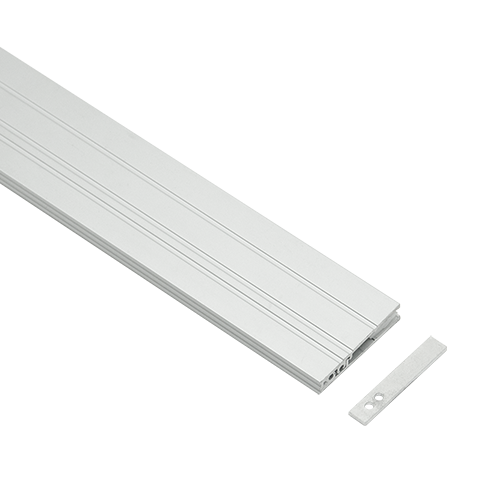
Where the fixture should disappear, an 8–12 mm body in a reveal reads as a line of light rather than a fitting. That is the whole point, and no wide body achieves it.
Where the detail is shallow, a 5 mm-deep rebate will not accommodate a 20 mm body. Slim is not a preference there; it is the only option.
Where the substrate is weak, a thin panel or a furniture carcass carries a small section without thought.
Where the run is short and decorative, a shelf edge, a niche, a wardrobe interior — output is not the driver.
Where does wide win?
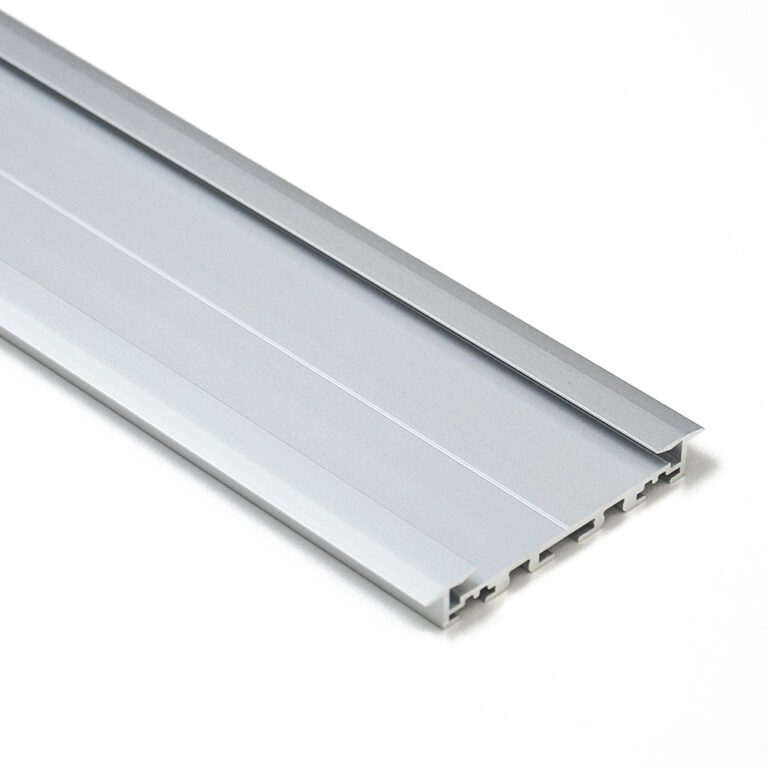
Where the light line is the design, a 60 mm body with a wide diffuser gives a band of light, not a line, in a reception ceiling or a retail soffit; that is the intent.
Where the strip is wide, a 25 mm or 32 mm strip requires a body to hold it. Slim bodies do not go that wide — the physical channel has to clear the PCB.
Where the load is high, more metal means greater thermal mass and more exposed surface area. A high-output or multi-row strip in a slim body will run hotter than the same strip in a wide one.
Where the body has to span, a wider, deeper section is stiffer, so it sags less between fixings — which matters on a suspended or ceiling run.
Why isn't a wide body automatically brighter?
Because the light line is set by the aperture the diffuser covers, and the strip behind it.
Put a single 12 mm strip into a 76 mm body, and the lit portion occupies a fraction of the aperture: bright in the middle, dim at the edges. That reads as a soft band rather than a crisp line, and the extra metal does nothing for output.
A wide body only produces more light if it carries more emitter — a wider strip, two strips side by side, or a multi-row board. Otherwise it is a wide housing with a narrow light line, which is a valid look but not a brighter one.
What decides whether a slim body is usable?
Not the width. The strip and the load.
Three constraints, in order:
- PCB width. A slim body takes a narrow strip — typically 4 to 10 mm in our range. If the project needs a 16 mm strip, the slim option does not exist regardless of how it looks.
- Watt per meter. A shallow, narrow section has little mass to absorb heat. Above moderate output, the body runs hot, and the strip's life is affected.
- Diffusion. A shallow cavity has little mixing distance, so a slim body with a clear cover shows dots at close range. Slim plus a high-density strip plus an opal cover is the combination that works.

What does our range actually look like?
The distribution is not what most people expect — the wide end is the larger group.
| Outer width | Perfis |
|---|---|
| Up to 12 mm | 11 |
| 12–20 mm | 32 |
| 20–35 mm | 48 |
| 35–60 mm | 59 |
| Over 60 mm | 68 |
Range: 8 mm to 264.6 mm outer width, median 45 mm. Strip compatibility runs from a 4 mm PCB to an 185 mm board.
So "slim" is the specialist end of the range, not the default. Most of what we make is 20 mm and up, because most projects are lighting a room rather than drawing a line in a ceiling.

Is slim the same as shallow?
No, and confusing the two causes more specification errors than any other pair of terms.
Width is measured across the section — how much the body occupies horizontally. Depth is measured into it — how far the diffuser sits from the strip.
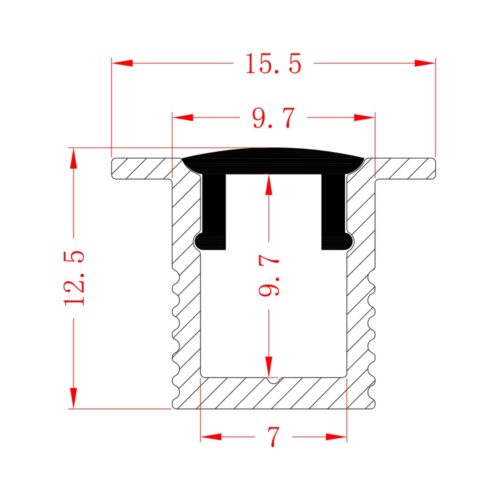
A body can be narrow and deep (a 12 mm-wide, 20 mm-deep slot profile) or wide and shallow (a 60 mm-wide, 8 mm-deep surface body). The two dimensions do different jobs:
- Narrow affects how little the fixture shows.
- Shallow affects how little it takes out of the room, and how little distance the light has to mix.
- Deep improves diffusion and adds mass; it does not make the body visually wider.
So a project that needs a discreet line and a dot-free output needs narrow and deep, not simply slim. A genuinely shallow body is a different specification, and it usually means accepting either a wider line or a visible dot pattern.
How do you decide?
Four questions, in this order:
- What is the strip? Its PCB width sets the minimum body. This comes first because it is not negotiable.
- What load will it carry? That sets the minimum mass and, therefore, a minimum section.
- How much room is there? Slot depth and available clearance set the maximum.
- What should the line look like? Thin line or band — this is the choice that is actually aesthetic.
Only the fourth question is about slim versus wide. The first three usually narrow it to two or three profiles before aesthetics gets a vote.
Our ultra-slim collection is the slim end, and the full range lists outer width, outer height, and PCB width for all 219 profiles, so the first three questions can be answered from the drawing.
Is a slim profile always dimmer?
No. The strip sets output, not the housing. A slim body with a high-density strip can be brighter than a wide body with a sparse one — it just has less capacity to carry the heat that comes with it.
Can I put a wide strip in a slim body?
No, and this is the error that stops installations. The channel has to clear the PCB. If the strip is 12 mm, the body has to take 12 mm, which rules out the slimmest sections entirely.
Does a wide body look more professional?
It looks more architectural, which is different. A wide body announces itself; a slim one disappears. Which is appropriate depends on whether the lighting is meant to be part of the interior or part of the architecture.
What is the practical limit for a slim body on load?
It depends on the section and the mounting, but the pattern is consistent: shallow bodies with little exposed surface are the first to run hot. If the body is too hot to keep a finger on after an hour, the section or the strip is wrong for the detail.
Can slim and wide profiles be used in the same room?
Yes, and often they should be — a slim line in a reveal and a wider band in a ceiling cove are different jobs. What does not work is switching mid-run: the two sections do not align, and the change reads as an error unless it happens at a deliberate break.

We design and supply LED aluminum profiles and linear lighting — over 200 profiles with matched diffusers and fittings, serving customers in more than 100 countries since 2007.
Related reading


Send the strip width, the run length and the destination — we will match the profile, the diffuser and the fittings, and quote within 1 business day.
Start your inquiry