



What Is a Lens Profile and When Does It Pay Off
A lens does not make a line brighter — it puts the light inside a fixed angle. Why working distance decides whether it works.
A lens profile is an aluminum channel with a prismatic cover instead of a flat diffuser. The lens does not make the line brighter. It directs the light within a defined angle — which means the fixture's overall performance depends on how far it sits from the surface it is lighting. Get that distance wrong, and a lens is worse than a cheap diffuser.
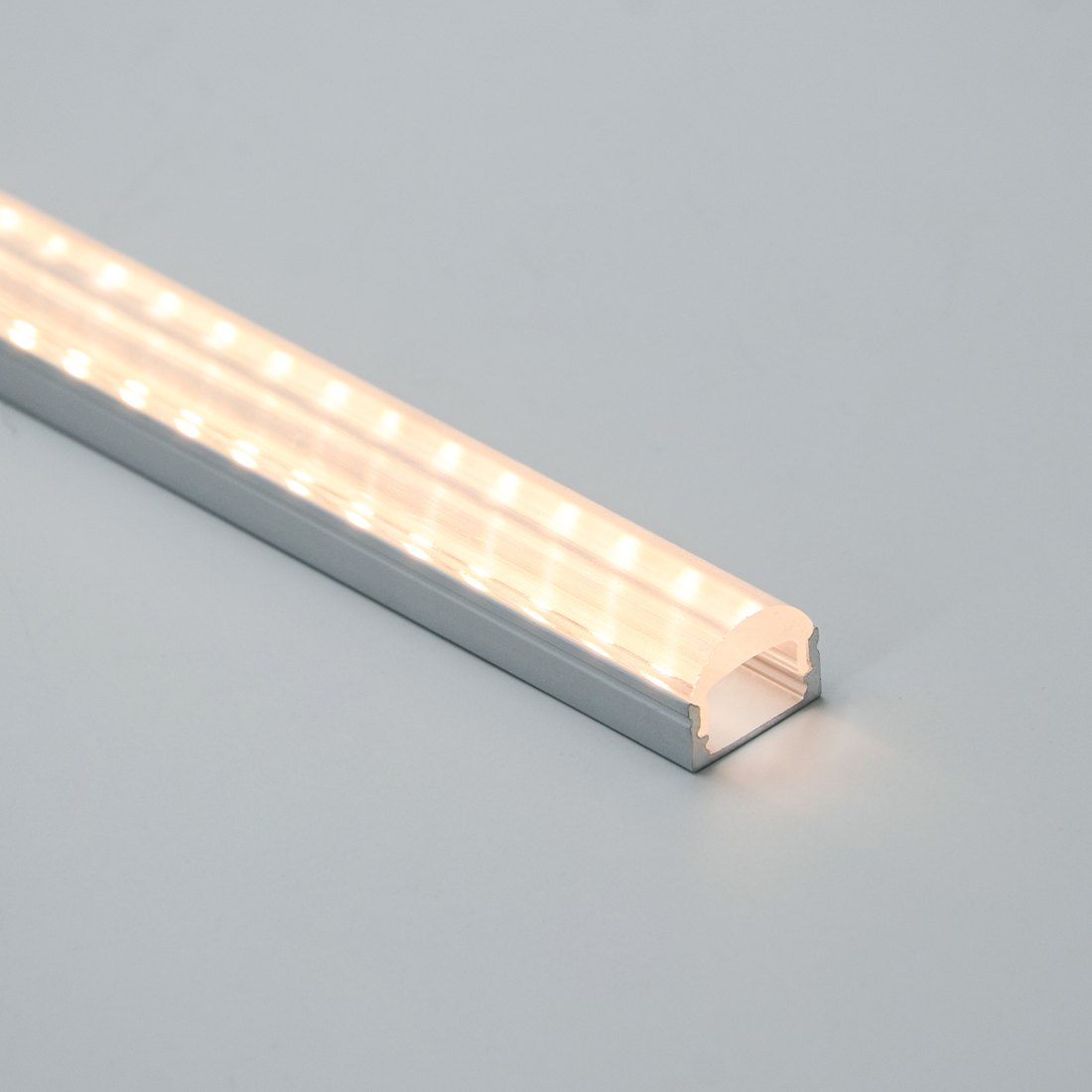
What does a lens actually change?
Two things, and they are opposites of what a diffuser does.
A diffuser spreads. Opal or frosted covers scatter light in all forward directions. The result is soft, even, and visible from a wide range of angles. Some output is lost in the scattering.
A lens concentrates. A prismatic cover refracts light into a narrower cone. The result is brighter within that cone and dark outside it, with less loss than a diffuser of the same transmission.
| Diffused cover | Lens cover | |
|---|---|---|
| Distribution | Wide, even | Narrow, defined |
| Visible from the side | Yes, softly | Barely — the cone points away |
| Output at the target | Lower, spread over a wide area | Higher within the cone |
| Sensitive to mounting distance | Mildly | Strongly |
| Controls glare | Yes, by scattering | Yes, by aiming away |
The last row is the reason lenses exist in architectural work: they solve glare not by softening the source but by pointing it somewhere the eye is not.
What is the cost of that focus?
Three costs, all real:
Outside the cone there is nothing. A diffused line lights the wall, ceiling, and floor a little. A line of light from a lens illuminates a strip on one surface and leaves everything else dark. That is the point — but it is also a hard edge if the design expected ambient light.
Distance becomes a specification. A 30° lens at 300 mm produces a band roughly 160 mm wide. The same lens at 900 mm produces a band about 480 mm wide at one-third the intensity. Move the profile and the design changes; this is why lens runs have to be set out from the target surface, not from the ceiling grid.
The cover is not interchangeable like a diffuser is. You can swap an opal for a frosted cover and get a slightly different line. Swapping a lens for a diffuser changes the distribution completely, and swapping one lens angle for another changes the geometry of the whole installation.
What angles exist, and how do you pick one?
Angles are usually quoted as the full beam width, and the common range runs from about 10° to 90°. The choice is arithmetic, not taste:
Required band width ÷ mounting distance = the tangent you need
If a display shelf needs a 200 mm band from a profile 300 mm above it, the ratio is 0.67 — roughly a 60° lens. If a wall texture needs a tight grazing line from the same distance, the ratio is much smaller and a 10–15° lens is right.
Two practical rules that follow:
- The tighter the angle, the more precisely the profile has to be aimed. A 10° lens with 5° of misalignment puts the band off target by nearly a tenth of the distance.
- The wider the angle, the more the lens behaves like a diffuser. Past about 60° the difference from a good prismatic diffuser is small, and the diffuser is usually the better buy.
What do our lens profiles look like?

Six bodies carry a lens, all with a PMMA cover.
| Model | Outer W × H | PCB width | Mounting |
|---|---|---|---|
| HL-BAPL002L | 17 × 13.7 mm | 12 mm | surface |
| HL-BAPL012 | 19.6 × 16.2 mm | 17 mm | surface |
| HL-BAPL034 | 19.6 × 17.8 mm | 16 mm | surface |
| HL-BAPL059 | 20.3 × 15.5 mm | 17 mm | suspended |
| HL-A033 | 31.8 × 17.2 mm | 25 mm | suspended |
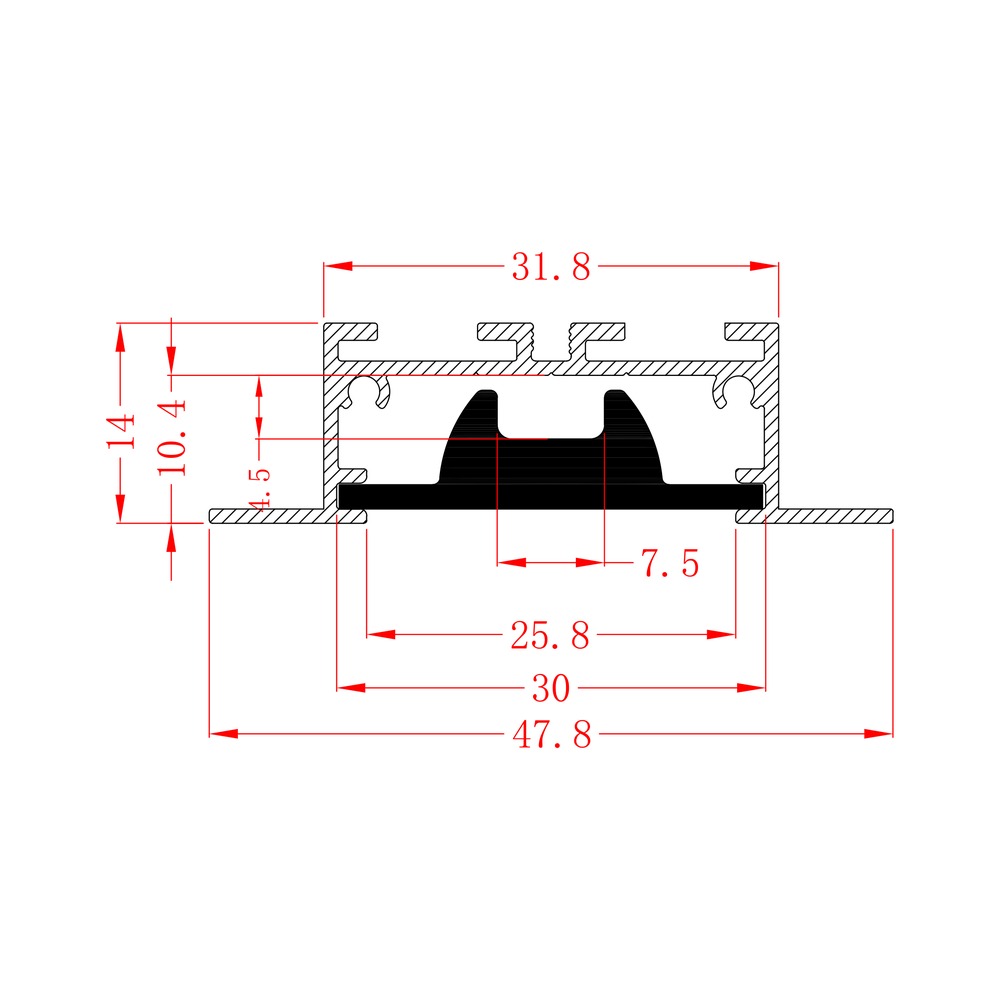
| HL-A032 | 47.8 × 14 mm | 25 mm | recessed |

The spread is deliberate: the smallest takes a 12 mm strip for shelf and case work, and the widest takes a 25 mm strip when the lens must cover a large emitter without beam spreading.

All six use PMMA rather than PC. A lens depends on holding a precise cross-section along its whole length; PMMA is stiffer and starts with higher transmission, which is what an optical element needs. PC's toughness is worth more on a cover that gets hit than on one that shapes a beam.
How do you aim a lens run?
A lens is the only profile type in which the fixing must allow adjustment, because the band moves when the body does.
Three approaches, in order of how much adjustment they leave:
Direct fix. Screws straight through the body into the substrate. Cheapest and most rigid, but the aim is set once — the position of the screw holes is the position of the beam.
Clip with slotted base. A mounting clip with an elongated screw slot lets the body move a few millimetres after fixing, then lock. This is the practical choice for shelf and case work, where the target is known but the tolerance is not.
Bracket or stem. For suspended runs, the suspension point lets both height and angle be set, which is what a long throw requires. The cost is that the body is visible and has to look deliberate.
Two checks worth doing before the run is fixed permanently:
- Mock up one meter at the intended distance and look at the band on the real surface. A lens on a matte wall and the same lens on polished stone are different installations.
- Check the prism orientation. The cover has a direction; fitted the wrong way round, the band is asymmetric and no amount of re-aiming fixes it.
When is a lens the wrong choice?
- General lighting. If the point is to light a room evenly, a lens will make a band and leave the rest dark.
- Short mounting distances with a wide target. Below about 150 mm, most lenses are still converging, and the band has not formed.
- Where the run will be adjusted on site, every re-aim changes the result; a diffuser is forgiving of a few millimetres.
- Where the surface is glossy, a focused beam on polished stone produces a hard reflection of the line, which is more visible than a diffused one.
If the project needs soft, wide, forgiving light, the answer is a diffused cover — and the lens collection is not where the specification should start.
How do you specify one?
Three figures, in this order:
- The band width you need on the target surface.
- The distance from the profile to that surface.
- The strip's PCB width, which sets the smallest body that can carry enough emitter for the band.
Then check the aim: a lens run needs a fixing method that lets it be adjusted and locked, and a section drawing that shows which way the prism faces. Send the first two figures, and we will confirm which of the six bodies fits — the full range lists every dimension.
Is a lens profile brighter than a diffused one?
At the target, usually yes — less light is scattered away. Along the run, no: the total light leaving the fixture is set by the strip, and the lens only redistributes it.
Can I swap a lens cover for a diffuser later?
Mechanically, sometimes. Optically, it changes the installation: the beam becomes a wash, the glare control is gone, and the reason for choosing a lens disappears. Treat the cover as part of the specification, not an accessory.
What is the difference between a 30° and a 60° lens at the same distance?
The band is about twice as wide and roughly a quarter as intense, because the same light is spread over four times the area. Which is right depends on the target, not on preference.
Do lens profiles work on walls as well as ceilings?
Yes, and they are often better on walls: a vertical run with a narrow lens grazes a textured surface, which shows the material rather than flattening it. The mounting distance from the wall is the figure to fix first.
Why do lens profiles cost more than diffused ones?
The cover is an optical component — the prism geometry must hold along its full length, and PMMA is the material that makes this possible. That is a different manufacturing problem from extruding a flat diffuser.

We design and supply LED aluminum profiles and linear lighting — over 200 profiles with matched diffusers and fittings, serving customers in more than 100 countries since 2007.
Related reading


Send the strip width, the run length and the destination — we will match the profile, the diffuser and the fittings, and quote within 1 business day.
Start your inquiry