



How to Choose a Profile for a Low Ceiling
Low ceilings need a shallow body, not a narrow one. Which dimension decides it, how much a fixed profile costs you in headroom, and the 17 bodies under 10 mm.
Low ceilings are a height problem, and almost everyone solves it by looking at width. What matters is the outer height of the body — the number that comes off the available headroom — plus how much the fixing projects. In our 219-profile range, 17 bodies are 10 mm or shallower, and the shallowest is 5 mm.
The number that decides it
A profile has three geometry figures: outer width, outer height, and the strip width it takes. On a low ceiling, only one of them costs you anything.
Outer width runs horizontally. A 60 mm-wide body and a 15 mm-wide body take the same headroom off the room. Width matters to how the line looks, not to how tall the room feels.
Outer height runs vertically, downward into the room. On a surface-mounted run, that is exactly what you lose. This is the specification.
A common mistake: choosing a narrow body because it looks discreet, then discovering it is 60 mm tall. It happens because “slim” is used as a marketing word rather than a dimension.
The clearest example in our own range
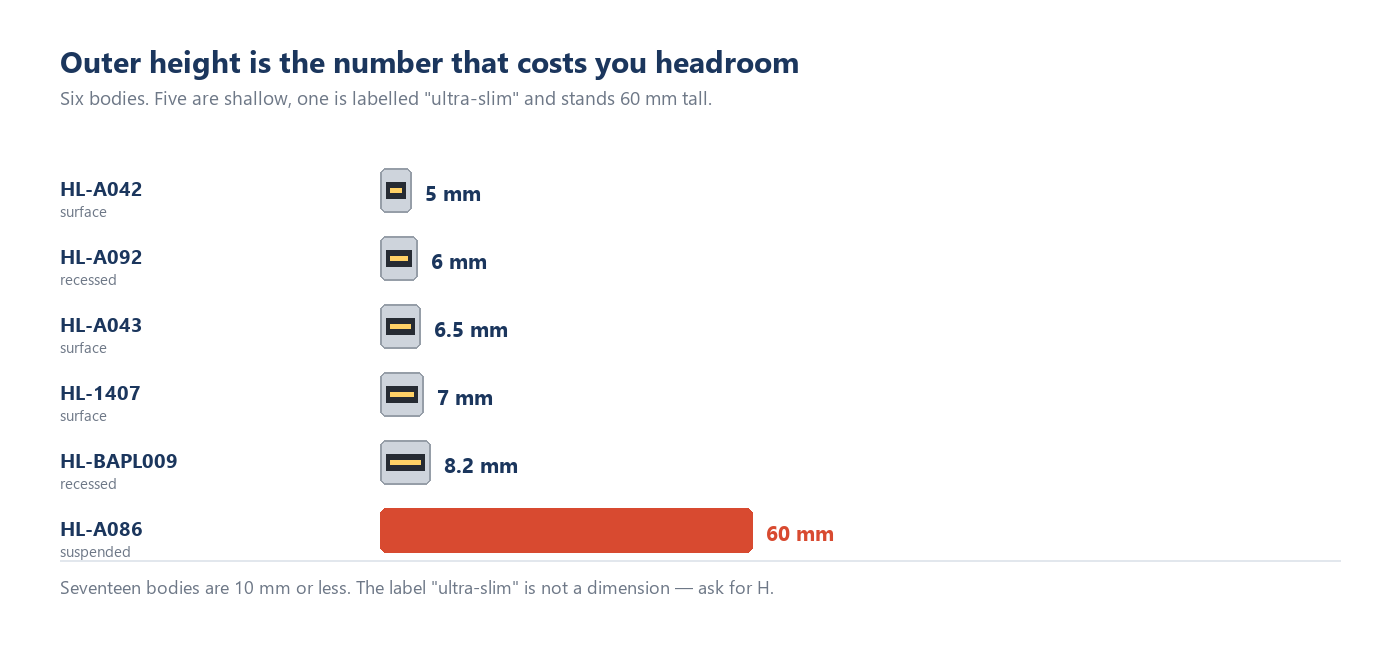
Two profiles are both labelled ultra-slim. Their heights are not close.
| Model | Outer W × H | Strip | Mounting | What it is |
|---|---|---|---|---|
| HL-BAPL009 | 19.1 × 8.2 mm | 9 mm | recessed | A genuinely shallow body |
| HL-A086 | 10 × 60 mm | 5 mm | suspended | A narrow, tall pendant |
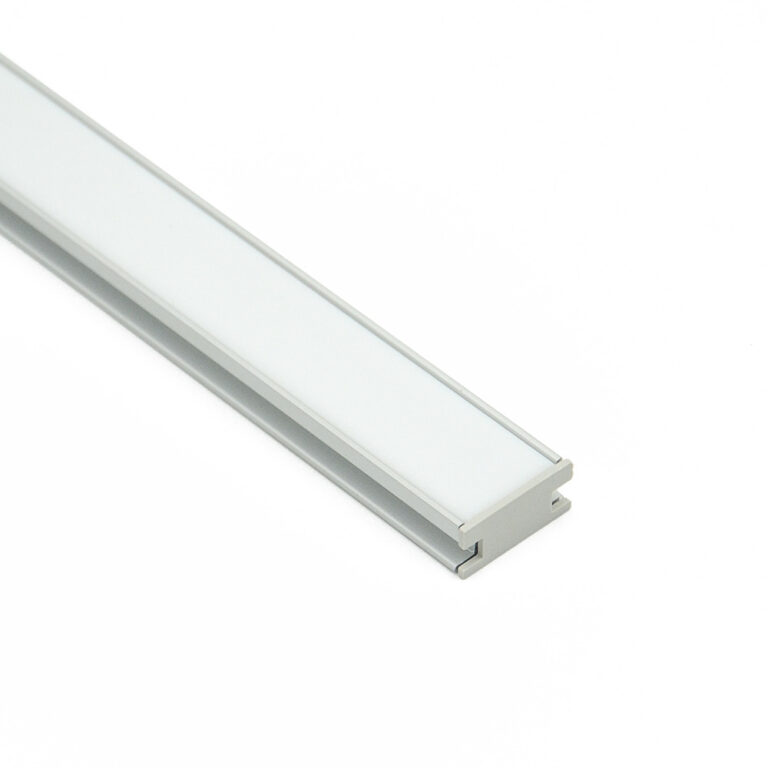
HL-A086 is “ultra-slim” because it is 10 mm wide. It is also 60 mm tall — seven times the height of the other. On a 2.4 m ceiling, one of these is invisible, and the other hangs into the room like a batten.
The lesson is not that the label is wrong. It is that a label is not a dimension. Ask for H.
Which bodies are actually shallow
If the constraint is headroom, filter by height, not by name. The distribution across our range:
| Outer height | Profielen | Typical use |
|---|---|---|
| 8 mm or less | 4 | Tightest ceilings, reveals, joinery |
| 10 mm or less | 17 | Most low-ceiling residential and retail work |
| 12 mm or less | 27 | Standard shallow surface runs |
| 15 mm or less | 46 | Where a slim line is wanted but depth is available |
| 20 mm or less | 79 | Half the range — a normal ceiling |
The four shallowest bodies, with their real dimensions:
| Model | Outer W × H | Strip | Mounting |
|---|---|---|---|
| HL-A042 | 15 × 5 mm | 8 mm | surface |
| HL-A092 | 35 × 6 mm | 4 mm | recessed |
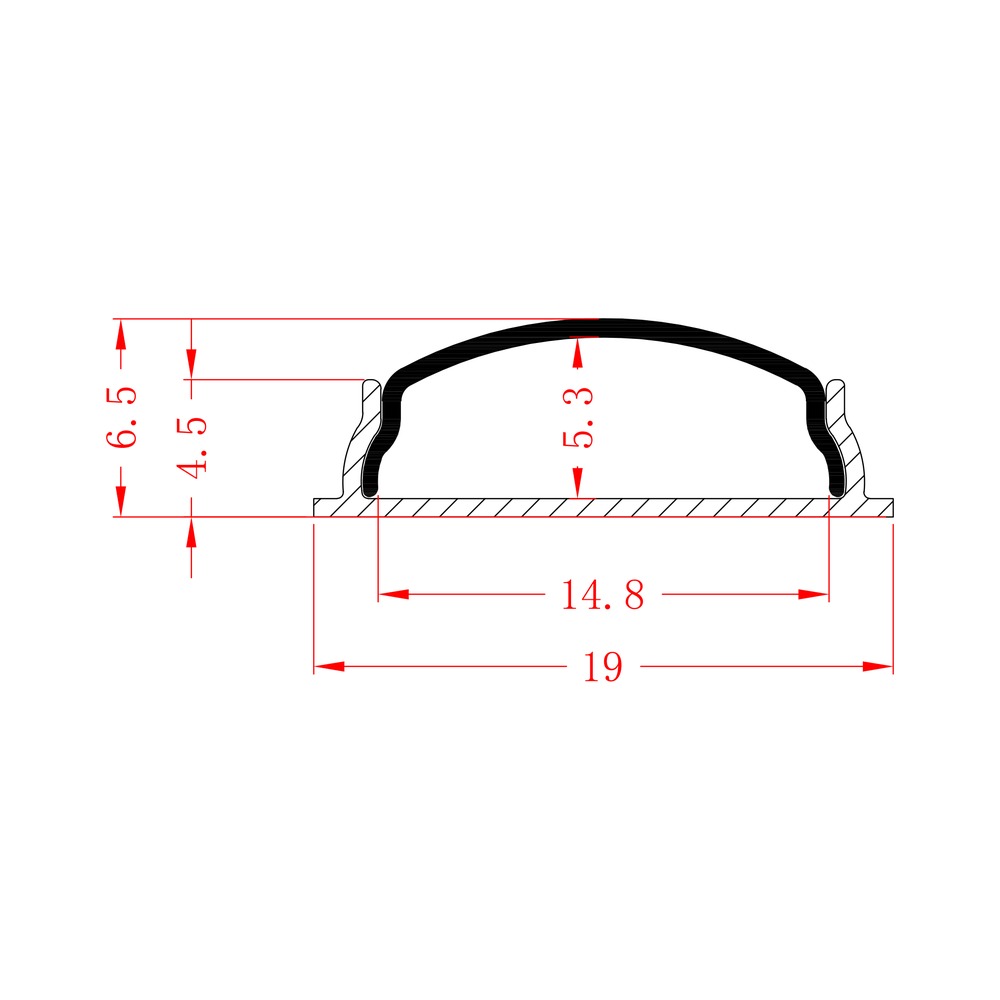
| HL-A043 | 19 × 6.5 mm | 12 mm | surface |
| HL-1407 | 14 × 7 mm | 12 mm | surface |

Note the trade in the second and third rows: HL-A092 is only 6 mm tall but takes a 4 mm strip; HL-A043 is 6.5 mm tall and takes a 12 mm strip. A shallow body does not automatically mean a narrow strip — but the shallowest ones do force you toward a smaller source.
Recessed or surface, when the ceiling is low
Both are viable, and the choice is about the void, not the height.
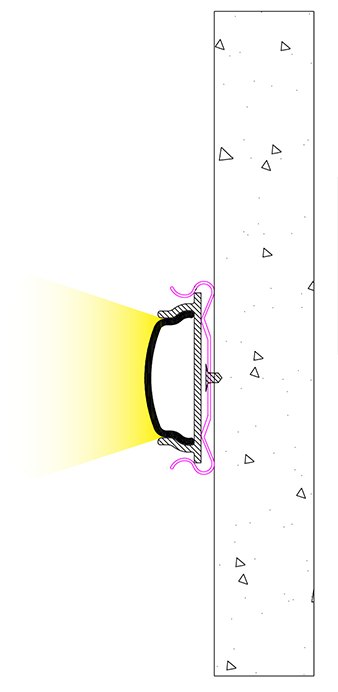
Recessed adds zero to the room. The body sits inside the board, and only the diffuser shows. On a 2.4 m ceiling, this is the only method that costs nothing in headroom — but it needs a void, and it needs the cut-out to be right, because on a low ceiling you are looking at that joint from closer.
Oppervlak adds the body height. On a 5–7 mm body, that is negligible; on a 15 mm body, it is a visible band. Surface is the practical answer where there is no void — a concrete soffit, a finished ceiling, a retrofit.
Geschorst is the one to avoid. Even a short drop brings the fixture into the sightline, and on a low ceiling the drop is what people notice first. If a suspended look is wanted for its direct/indirect effect, the ceiling is usually not the place for it.
One practical note on recessed in low rooms: the driver still has to go somewhere. On a shallow void, a recessed body plus a driver may not fit in the depth available. Check the driver height as well as the profile height — a number that rarely appears on either datasheet.
Glare gets worse as the ceiling drops.
This is the effect that shows up after installation, and it is not in any selection chart.
Glare depends on the angle between the source and the eye. Lower the ceiling, and that angle flattens — you are looking at the diffuser more edge-on, and a bright line at eye level is far more uncomfortable than the same line at 3 m.
Two consequences for the specification:
A short checklist
Four numbers, in this order, before you order:
The bodies in the shallow end of the range are listed under ultra-slim profiles, and every model page carries its own section drawing. If the available depth is unusual — a furred-down bulkhead, a services zone, a coffered slab — send the section, and we will confirm which bodies clear it.
FAQ
What is the shallowest LED profile available?
In our range, 5 mm outer height (HL-A042, 15 mm wide, taking an 8 mm strip). Four bodies are 8 mm or less, and 17 are 10 mm or less. Below 6 mm, the choice of strip narrows considerably.
Is a narrow profile also a shallow one?
No. Width and height are independent. HL-A086 is 10 mm wide and 60 mm tall. Choosing by width is how a low ceiling ends up with a deep body hanging into the room.
Can I use a recessed profile in a low ceiling?
Yes, and it is the best option for headroom because it adds nothing. It requires a void and an accurate cut-out, and in a shallow void the driver may not fit alongside the profile — check both heights.
Does a low ceiling make glare worse?
Yes. Lowering the ceiling flattens the viewing angle to the diffuser, so the same output is more uncomfortable at eye level. A diffusing cover and, where possible, an angled or corner body matter more than they would at 3 m.
How much headroom does a surface-mounted profile take?
Its outer height, plus a millimeter or two for the fixing. A 5–7 mm body is effectively invisible; a 15 mm body reads as a band and needs a pelmet or a deliberate design treatment.
Related links
See also: Recessed vs surface vs suspended, en the trimless case.

We design and supply LED aluminum profiles and linear lighting — over 200 profiles with matched diffusers and fittings, serving customers in more than 100 countries since 2007.
Related reading
Send the strip width, the run length and the destination — we will match the profile, the diffuser and the fittings, and quote within 1 business day.
Start your inquiry