



What Is an LED Aluminum Profile and Why Do You Need One
Un boîtier en aluminium extrudé qui assure le refroidissement de la bande, la protège et donne sa forme à la ligne. Le rôle d’un profilé — et les trois chiffres qui déterminent son adaptation.
An LED aluminum profile is an extruded aluminum channel that holds a strip, pulls heat out of it, and gives the light a defined edge. It is not an accessory you add at the end. Three numbers decide whether your strip fits at all: outer width, outer height, and the strip width it takes. No amount of good installation fixes a wrong section.
What does a profile do?
It does three things, and they are worth separating because catalogs blur them together.
It carries heat away from the PCB. An LED strip generates heat in a small area. Aluminum conducts that heat into the body of the extrusion and out through its surface. Without a body to conduct into, the heat stays where it was made.
It holds the line straight. An aluminum extrusion is rigid. A strip on its own follows whatever surface it sticks to. That might be a slightly bowed cabinet base, a drywall joint, or a length of timber that has moved. In a 1.5 m run, the difference shows as a wave in the light line.
It gives the diffuser something to sit in. The cover is what turns a row of diodes into a line. Without a channel, nothing holds the cover at a fixed distance from the strip, and that distance controls how much the diodes blend.
Everything else a catalog says, such as protection from dust, a professional finish or design freedom, follows from those three.
Why not stick the strip to the surface?
You can, and for a short run in a hidden location it will work for a while. Here is what changes when you add a profile.
| Bare strip on a surface | Strip in an aluminum profile | |
|---|---|---|
| Chemin thermique | PCB → adhesive → substrate | PCB → adhesive → aluminum → air |
| Straightness | Follows the substrate | Set by the extrusion |
| Diode visibility | Every diode visible | Controlled by cover and cavity depth |
| Protection de l'environnement | Aucun | Dust, knocks, and water if sealed |
| Service | Strip is destroyed on removal | Strip and cover are replaceable |
The heat row matters most, and it is also the most often overstated. A profile does not make a strip run cool. It gives the heat somewhere to go. Put a high-output strip in a shallow body, and the body still gets hot. It gets hot more evenly than a strip stuck to wood.
Which three numbers decide whether it fits?
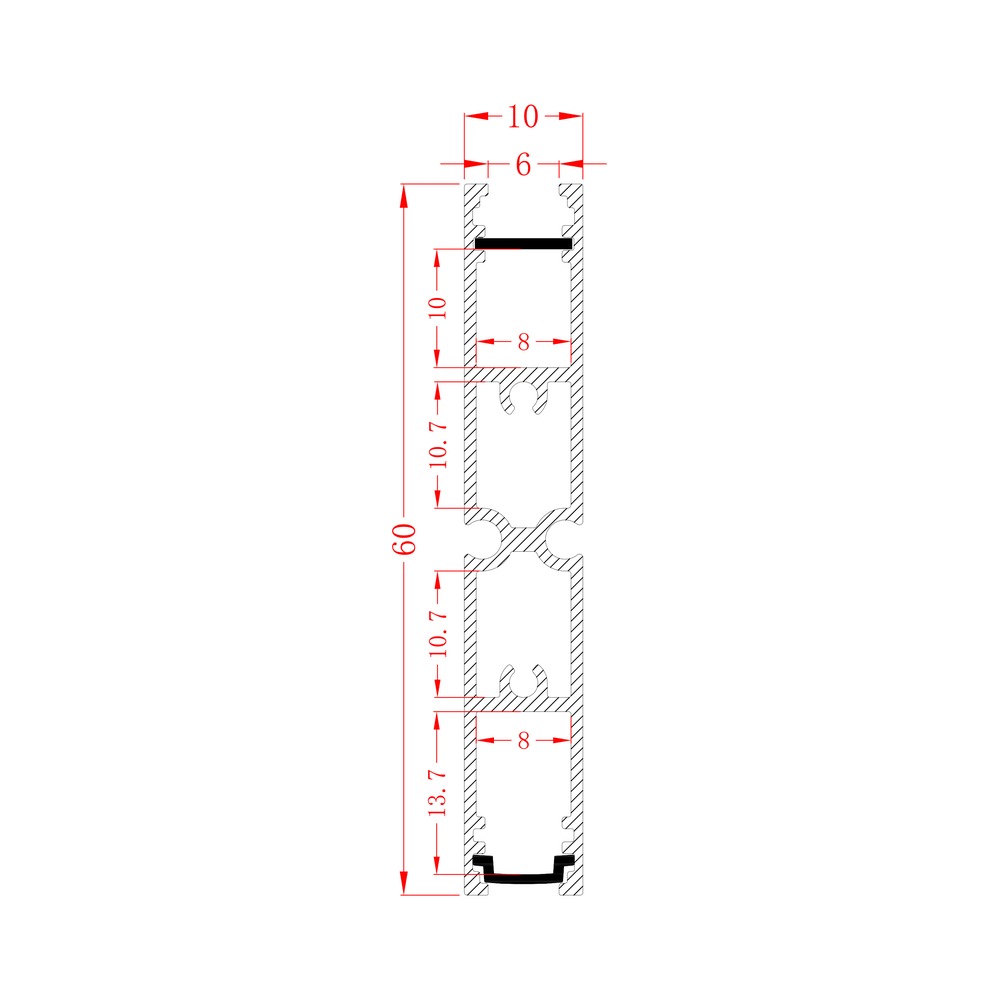
Every profile in a catalog has three dimensions, and buyers routinely pick the wrong one. The one that decides fit is the PCB width.
Outer width is the silhouette. It decides how much visual weight the line has, nothing else.
Outer height is what the profile takes out of the room on a surface run. On a recessed run, it is how deep a slot the body needs.
PCB width is the strip the body is built around. This is the compatibility figure, and our listings quote it. A 10 mm strip pairs with a 10 mm profile, and the physical channel around it is wider.
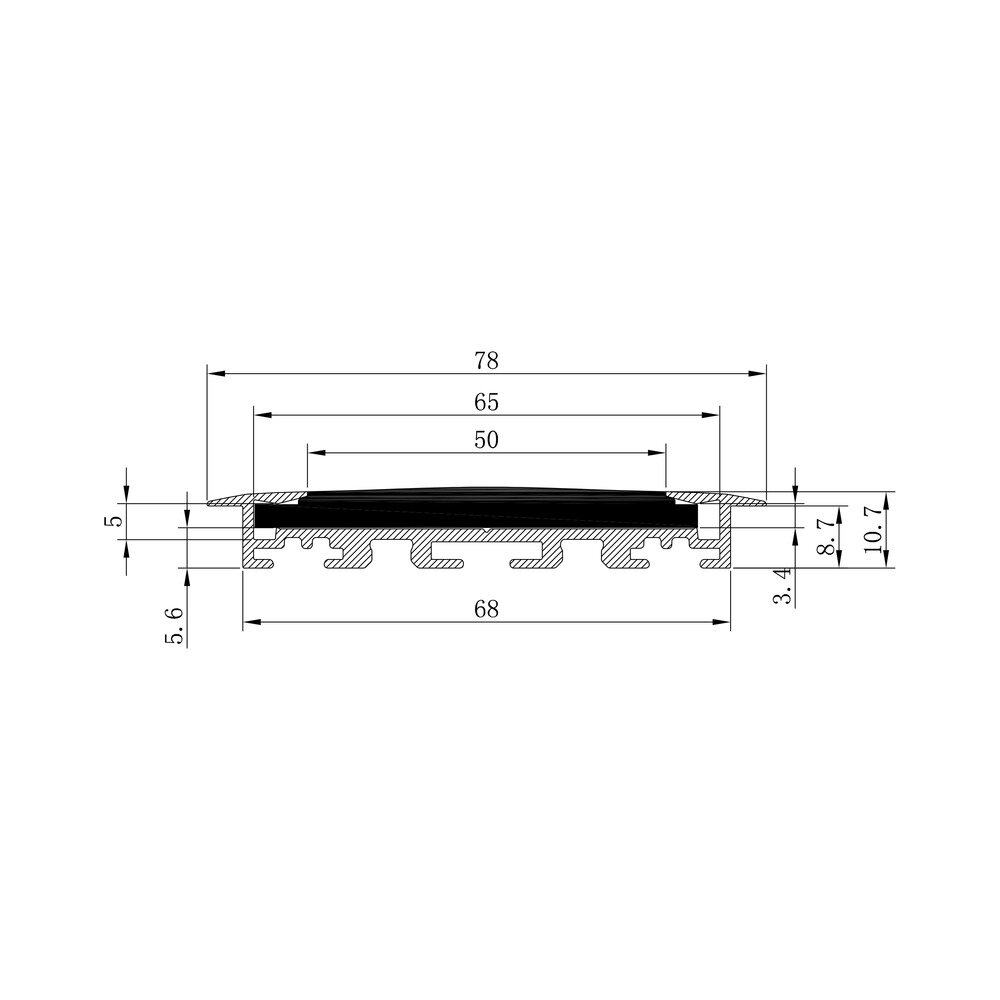
Confusing outer width with PCB width is the single most common ordering error. A 78 mm wide body and a 15 mm wide body can both take a 5 mm strip. The difference is how the line looks, not what fits inside.
How many kinds are there?
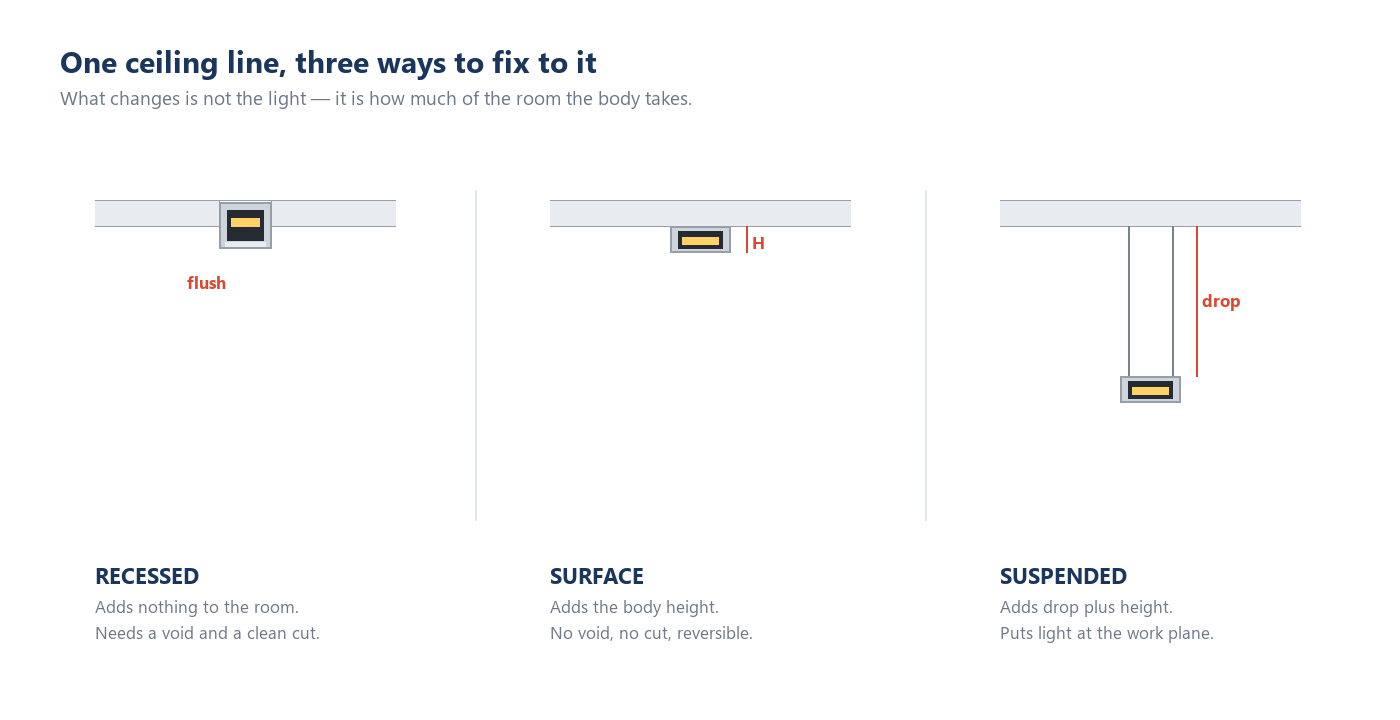
More than a catalog suggests, and the useful way to sort them is by how the body is fixed, not by shape.
| Montage | Profiles in our range | Where it goes |
|---|---|---|
| Suspendu | 83 | Below the slab, visible, can light up and down |
| Encastré | 75 | Inside a board or slot, aperture only |
| Surface-mounted | 50 | Onto the finished face |
| Coin | 11 | Into a 90° junction, throws light across a surface |
Around those four sit eleven application collections. They are under-cabinet, ultra-slim, wet-area, mini, lens, wall, floor and stair, flexible, dual-emitting, black anodized, and ceiling. A profile can appear in more than one, because a 10 × 10 mm body can be both a mini section and a cabinet profile.
That matters at quoting stage. 76 of 219 profiles list a second mounting option, and 143 do not. If a project might change method between drawing and site, someone has to choose that flexibility, not assume it.

What comes with a profile?
Not much, and the gaps are predictable.
| Accessory | Profiles that include it | Remarque |
|---|---|---|
| End cap | 210 of 219 | Usually one closed, one with a cable hole |
| Diffuseur pour PC | 180 | The default cover |
| Mounting clip | 151 | Cheaper bodies often ship without |
| Suspension rope | 88 | Only relevant to the suspended group |
| Diffuseur en PMMA | 76 | The alternative cover where optical quality matters |
| Connector | 71 | For joining runs; check it matches the section |
| Silicone diffuser | 10 | Only where the cover has to bend |
The two that catch people out are the clip and the connector. A body without clips needs a fixing method designed before it arrives. A connector is section-specific, so it will not bridge two different profiles.
What does a profile not do?
Three claims are worth pushing back on.
It does not waterproof a fixture. An extrusion is an open channel with a capillary seam along the cover groove. Water resistance is created at assembly: cover seated, caps sealed, cable entry glanded. We do not claim an IP rating for any aluminum profile.
It does not increase output. The strip sets the light. The profile sets how it is seen. A profile can lose light through a diffuser, and it cannot add any.
It does not fix a bad layout. A profile makes a line look intentional. It cannot make an under-lit counter bright or a badly spaced run even.
So do you need one?
If the strip is visible, runs more than a meter, or sits anywhere it will be touched, cleaned or exposed to steam, yes. Then the decision is which section, not whether. If it is a short hidden run in a dry cavity at low output, a bare strip is defensible. A profile is optional.
The useful next step is not to pick a shape. Write down the PCB width of the strip, the available depth, and how the body has to be fixed. Those three answers narrow 219 profiles to a handful, and the full range lists all three figures for every model.
Do LED profiles extend strip life?
They give heat a path out of the PCB, and heat is what shortens life. How much that matters depends on the output of the strip and the mass of the body. A low-output strip in a deep body will barely notice. A high-output strip in a shallow one will.
Is aluminum better than plastic for an LED channel?
For heat, yes, by orders of magnitude, not by percentages. Plastic still has uses, such as a curved run or a low-output decorative line. But it is a different product with a different job, not a cheaper version of the same one.
Can I cut a profile to length on site?
Yes. A non-ferrous blade or a fine-toothed hacksaw leaves a clean cut in 6063-T5, and the cut edge needs deburring before the strip goes in. Keep the cover in place while cutting to avoid swarf entering the channel.
Do I need a diffuser?
Only if the diodes would otherwise be visible. A concealed run facing away from view can use a clear cover, or none. Any visible run needs a diffusing cover, and that goes double above a reflective surface. Without one, the line reads as a row of dots.
What length do profiles come in?
Any length up to 4 m is supplied as one piece, cut to your size. For a long run, one continuous piece per run is cleaner than joining. When a join is unavoidable, it leaves a visible seam and a shadow line.
See also: tolerance and cut quality on the same sections, and HL-A010.

Nous concevons et fournissons des profilés en aluminium pour éclairage LED et des systèmes d'éclairage linéaires — plus de 200 modèles assortis de diffuseurs et de luminaires adaptés — et nous accompagnons nos clients dans plus de 100 pays depuis 2007.
Lectures complémentaires


Indiquez-nous la largeur de la bande, la longueur totale et la destination : nous sélectionnerons le profilé, le diffuseur et les raccords adaptés, et vous enverrons un devis dans un délai d'un jour ouvré.
Lancez votre demande