



6063-T5 vs 6061: Which Alloy for Extrusion
6061 is stronger and that is rarely the deciding factor. What each alloy demands in wall thickness, anodizing and die design — and when 6061 is right.
The default answer — "6061 is stronger, 6063 finishes better" — is correct and nearly useless, because an LED profile rarely needs the strength. The decision is really about three things: how thin the walls can be, how the anodizing comes out, and whether the die can be cut at all. Strength enters only when the profile spans something.
What actually differs?
| 6063 | 6061 | |
|---|---|---|
| Alloying | Lean Mg-Si | More Mg-Si, plus copper |
| Yield strength (T5/T6) | ~110–145 MPa | ~240–275 MPa (T6) |
| Extrudability | Best of the 6xxx family | Moderate — thicker walls, slower press |
| Thin-wall capability | 1.0–1.2 mm routine | Difficult below ~1.5 mm |
| Anodizing | Bright, uniform, takes dye evenly | Can come out gray or mottled |
| Machining after extrusion | Soft, gummy | Clean chips, holds tolerance |
Why is 6063 the default for LED profiles?
Because the requirements of an LED profile align with 6063's strengths and move away from its weaknesses.
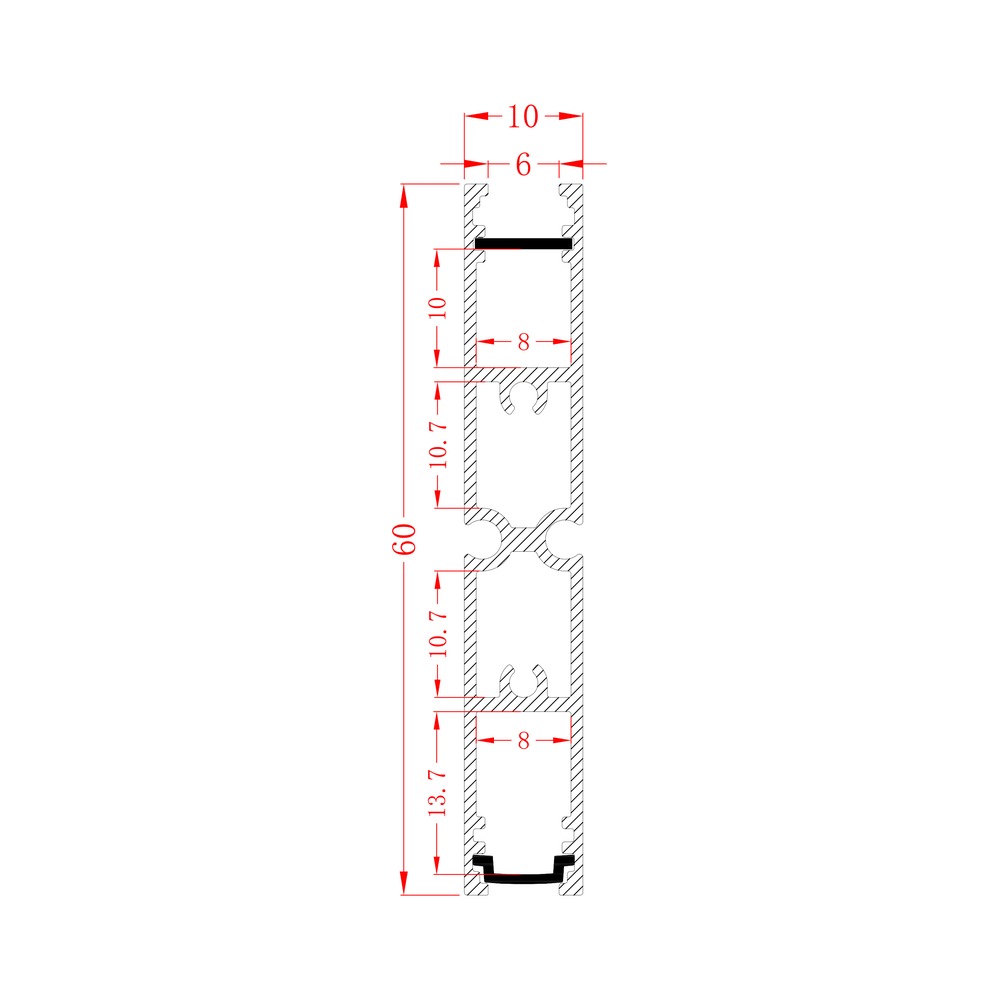
The walls have to be thin. A channel that takes a 10 mm strip and sits in a 12 mm slot has very little metal in its section. 6063 extrudes that shape at production speed; 6061 tends to need thicker walls and larger radii to run reliably, which changes the section.
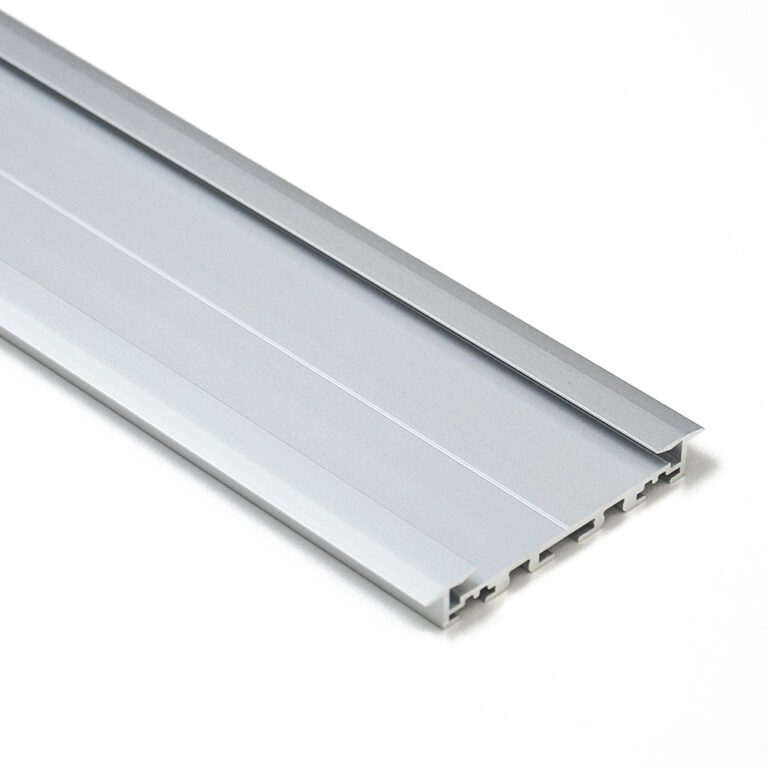
The surface is part of the product. A profile is often visible and often anodized. 6063 anodizes to a bright, even film and takes dye across a batch without patchiness. 6061's higher silicon and iron content produces intermetallic particles that disrupt the oxide layer — resulting in a slightly gray, less uniform finish. For a decorative part, that is a real penalty.
The strength is not needed. A profile carries a strip, a cover and itself. Where a run spans a distance, the limiting factor is stiffness — how much it sags — not yield strength. Stiffness comes from section geometry, not from alloy.
When would 6061 make sense?
Three cases, all of them about something other than light.
A genuinely structural detail. A profile used as a structural rail, a mounting spine for other components, or a body that carries a load beyond its own weight. If the profile is doing structural work, 6061 is the right conversation.
Heavy post-extrusion machining. Suppose the part needs extensive drilling, milling, or tapping after extrusion; 6061 machines cleanly, whereas 6063 smears. A profile that is 30% machined feature is a machining job that happens to be extruded.
Very large sections with wind or impact load. At sizes where the section itself becomes a structural element, the strength difference starts to matter rather than being theoretical.
Notice what is not on that list: heat dissipation.
Does the alloy change heat dissipation?
Very little, and it is the wrong reason to choose.
Both alloys are aluminum, and their thermal conductivity is close — the difference between them is small compared with the difference between aluminum and any plastic, or between a thick section and a thin one. If a body is running hot, the causes are almost always the section, the contact between strip and metal, or the airflow around the body — not the alloy.
What affects conductivity is composition control, not the grade name: aluminum with high recycled content and mixed alloying can fall noticeably below the conductivity of virgin 6063. That is a supplier question, not a 6063-versus-6061 question.
What do you give up with 6061?
Three things, and they are concrete:
Thin walls. The section that was drawn for 6063 may not extrude in 6061 without thickening. Thicker walls change the fit — the channel, the cover groove and the outer envelope all move.
Anodizing quality. If the profile is visible and anodized, 6061 will show it. Powder coating hides the difference; anodizing does not.
Lead time and die demand. 6061 runs slower through the press and may need a larger one, and its die design is less forgiving of thin walls, on a large order that shows up in the schedule before anything else.
What about the temper?
Separate question, and worth keeping separate. T5 and T6 are heat treatments; both alloys can be supplied in either. For a profile to be bent after extrusion, T5 is the practical choice regardless of alloy, as T6 is prone to cracking. The alloy decides what shape you can extrude; the temper decides whether you can form it afterwards.
The full explanation of what each designation means is in our guide to 6063-T5 — this article only covers the choice between alloys.
What about 6082, or 6060?
Two more grades appear in quotations, and both deserve a short answer.
6082 is a high-strength structural alloy commonly used in European structural work. It extrudes less readily than 6061 — higher press force, simpler sections — and it anodizes less evenly. For an LED profile it is the wrong end of the trade: more strength than the part can use, less shape freedom than the section needs.
6060 sits just below 6063 in alloying content. It extrudes even more easily and anodizes well; in practice, it behaves much like 6063, with slightly lower strength. Some suppliers use it interchangeably. If a drawing says 6063, it is worth confirming which one is being quoted rather than assuming.
The useful rule: for a thin-walled visible profile, the choice is 6063 or something very close to it. Grades above that trade shape freedom and finish quality for strength the part does not need.
How do you specify it?
Start from the section drawing, not from the alloy name.
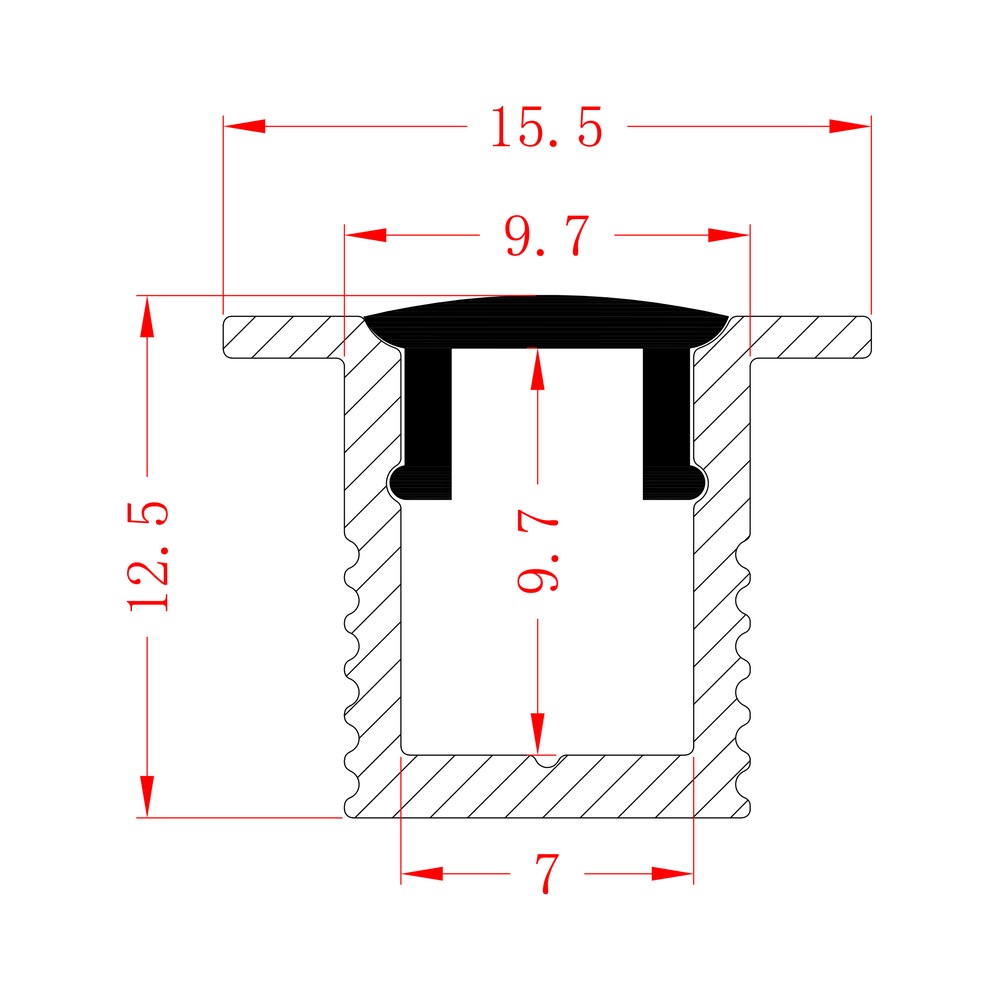
- Draw the section the application needs — channel width, wall thickness, cover groove.
- Ask which alloy can be extruded to the required tolerance. In practice, for thin-walled visible profiles, that is 6063.
- State the temper separately, because it is a different decision.
- Ask about recycled content if the part is doing thermal work.
If a supplier offers 6061 for a standard decorative profile without being asked, it is worth asking why. Sometimes there is a reason — a heavy machined bracket, a structural rail. Often there is not, and the section has been quoted in whatever was on the press.
Our range is 6063 throughout, because every model is a thin-walled visible section — the case where 6063 is not a compromise but the correct answer.
Is 6061 stronger in a way that matters for a suspended profile?
Not for the span most installations use. A suspended body is limited by sag between suspension points, and sag is a stiffness question — geometry, not alloy. Where suspension points are very far apart, a deeper section does more than a stronger alloy.
Can a 6063 profile be used outdoors?
Yes, anodized or powder-coated. 6063's lower copper content actually gives it a slight edge over 6061 in coastal or industrial atmospheres, where copper-rich particles in 6061 can initiate pitting.
Why does 6061 anodizing look gray?
Higher silicon and iron content creates intermetallic particles that interrupt the oxide layer as it grows. The film is there, but it is less uniform, and dye takes unevenly. Powder coating covers it; clear anodizing does not.
Is 6063 available in T6?
Yes. It is stronger than T5 and less formable, and it is used where a section needs more rigidity and will not be bent. For most LED profiles, the temper is T5, because bending and surface quality matter more than the extra strength.
Is 6063 easier to source in small quantities?
Yes. The majority of extruded profiles worldwide are 6063, so it is stocked and pressed more widely. A small order in 6061 may wait for a press slot or carry a die minimum that 6063 would not.

We design and supply LED aluminum profiles and linear lighting — over 200 profiles with matched diffusers and fittings, serving customers in more than 100 countries since 2007.
Related reading

Send the strip width, the run length and the destination — we will match the profile, the diffuser and the fittings, and quote within 1 business day.
Start your inquiry