



Why Aluminum Instead of Plastic Channel
Thermal conductivity differs by three orders of magnitude, but that is not the deciding factor. Where plastic works and where it fails.
A plastic channel is not a cheaper version of an aluminum one. It is a different product that solves a different problem. Aluminum conducts heat roughly 700 to 1,000 times better, but the property that decides most projects is not thermal at all — it is that a 1.5 m aluminum extrusion stays straight and a plastic one does not.
How big is the thermal difference, really?
Not "better" — a different order of magnitude.
| Material | Thermal conductivity | What it means in a channel |
|---|---|---|
| Aluminum 6063 | ~200–210 W/m·K | Conducts heat along and across the body |
| Polycarbonate (PC) | ~0.2 W/m·K | Insulates |
| PVC | ~0.15–0.2 W/m·K | Insulates |
These are published material constants, not measurements from our line. The ratio is roughly 1,000:1. In practice, that means an aluminum body spreads heat across its whole surface, while a plastic body lets it accumulate at the source.
That difference matters because of how LED life behaves with temperature: junction temperature and rated life follow an exponential relationship, and the common industry shorthand is that every 10 °C reduction roughly doubles life. A body that cannot conduct heat away does not get the benefit of that curve, no matter how good the strip is.
Where does the heat actually go?
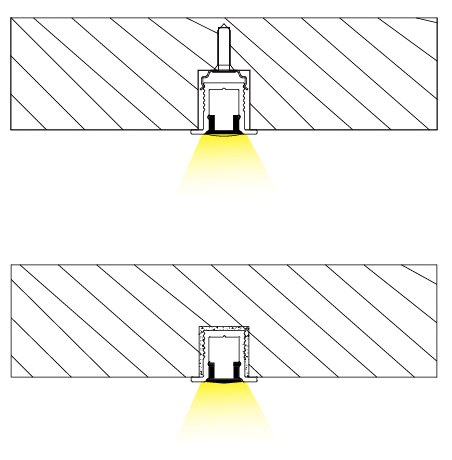
Follow the path, because it explains why "aluminum" alone is not a guarantee:
- LED junction → PCB. Heat is generated at the diode and spreads into the board.
- PCB → adhesive. This is the bottleneck most people miss. The backing tape is a thermal path, and it only works if it is in full contact across its width.
- Adhesive → extrusion floor. The aluminum has to be in contact, not merely nearby.
- Extrusion → air. The body's surface area and its temperature difference with the room do the rest.
A plastic channel breaks the chain at step 3: there is no conductor. An aluminum channel with a strip that is not pressed flat breaks it at step 2 — which is why clearance matters as much as material.
What does plastic do that aluminum cannot?
Three real advantages, and they are worth stating plainly:
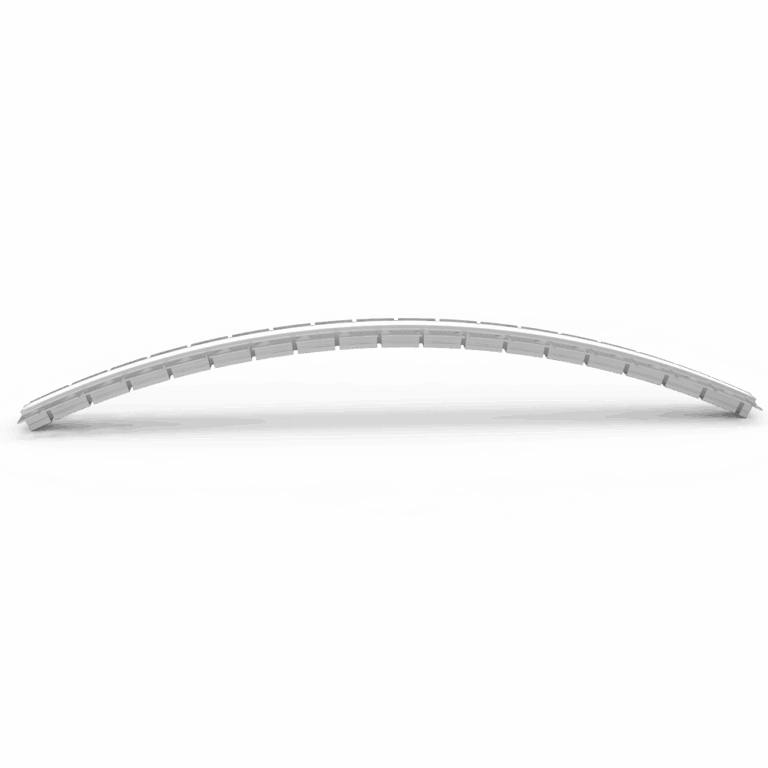
It bends. A curved cove, a radiused reception desk, an arched niche — extruded aluminum cannot follow that geometry. A flexible silicone or plastic sleeve can. We carry five flexible profiles for exactly this, and they are the right answer where the curve is the design.
It is light. On a weak substrate — a thin panel, a suspended ceiling tile, a piece of furniture not built for load — plastic adds almost nothing.
It costs less up front. Material and tooling are cheaper, and for a low-output decorative run,n that is a legitimate reason.
What does aluminum do that plastic cannot?

It stays straight. This is the property that decides more projects than thermal performance does. A 1.5 m plastic channel sags and twists between fixings; the strip inside follows, and the light line shows every deviation. Aluminum holds its section over that length, so the line reads as a line.
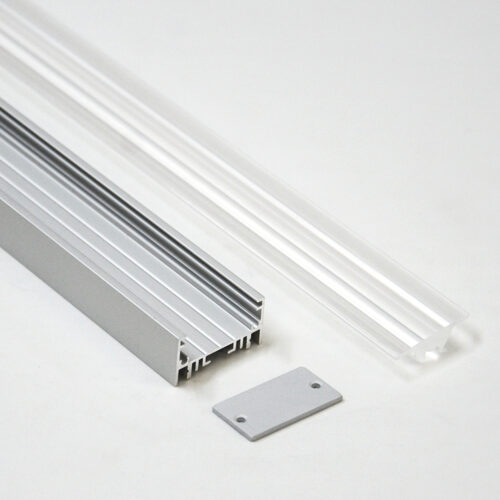
It can carry a real diffuser. A plastic channel often uses its own translucent wall as the diffuser. That wall has one transmission value and one diffusion character — you cannot change the beam. An aluminum body takes interchangeable covers: clear, frosted, opal, prismatic, or a lens. The cover becomes a design decision rather than a material side effect.
It takes a finish. Anodized or powder-coated, in a color that matches the ceiling or disappears into it. Plastic is whatever color it was molded.
It can be recycled as metal. Aluminum is recycled indefinitely without losing its properties; mixed plastics usually are not.
What about the layer between strip and body?
The material is only half the path. Between the PCB and the aluminum sits a piece of double-sided tape, and that tape is a worse conductor than either the board or the extrusion.
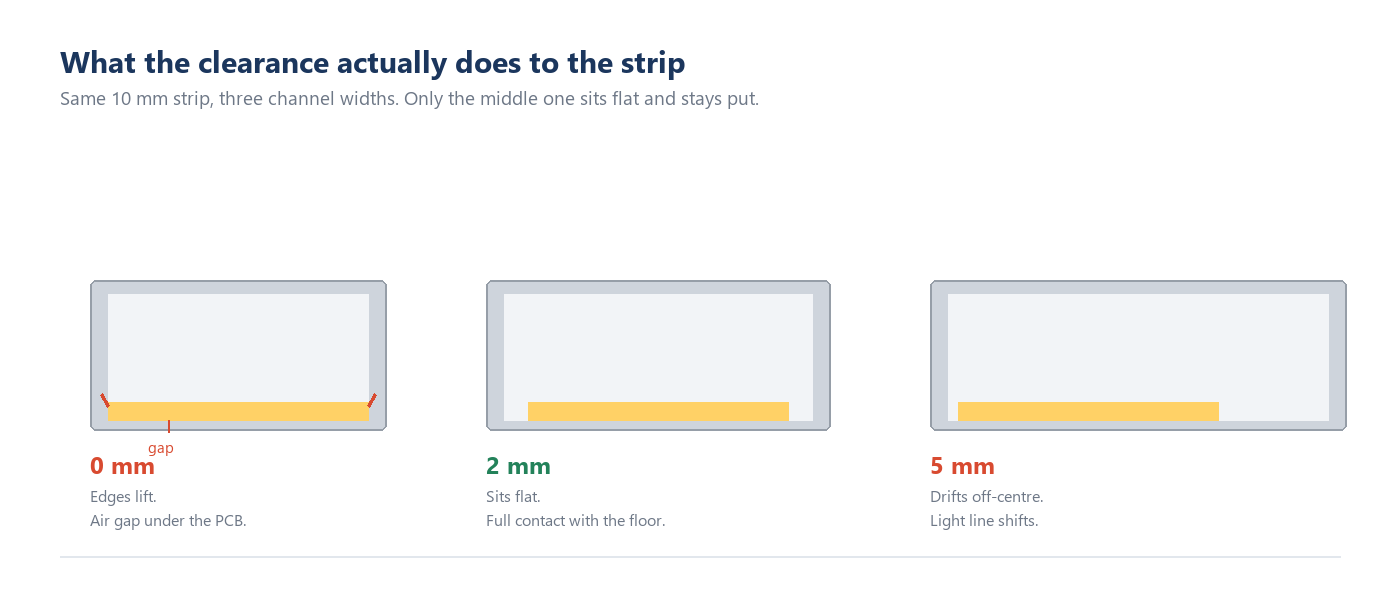
Its performance depends on contact, not on formulation. A strip pressed flat across its full width transfers heat into the body along that whole face. A strip with a raised edge — because the channel is exactly strip width, or because the surface was not cleaned, or because the run was stuck down in a cold room — touches only along a line, and the rest of the tape becomes insulation instead of a path.
This is why the two failure stories sound different but share a cause:
- In a plastic channel, there is no conductor at the end of the path, so contact quality barely matters — the heat stops there either way.
- In an aluminum channel, contact quality is the variable. The same extrusion performs very differently depending on whether the strip is seated flat.
Practical consequences, all cheap to get right:
- Allow 1–2 mm of clearance so the strip lies flat instead of wedging.
- Clean the channel floor before adhesion — dust and swarf defeat contact.
- Bring the profile and strip to room temperature before sticking; cold tape grabs early and holds badly.
- Press along the whole length, not at the ends. Contact is a length property.
None of this appears on a datasheet, and all of it decides whether the aluminum you paid for actually does its job.
So where does plastic actually belong?
Three cases where it is the correct choice, not a compromise:
- A curve the design depends on. If the run bends, the material has to bend.
- Low output over a short distance. A 4–5 W/m strip in a 400 mm decorative reveal does not generate enough heat for the material to matter, and the channel is not long enough for straightness to show.
- Hidden and disposable. A temporary installation, a prototype, a display that comes down in a month.
And where does it fail?
- Any run over about a meter will be looked at. Straightness, not heat, is what fails first.
- High-output or COB strip in a shallow body. The heat has nowhere to go, and the plastic around it insulates.
- Anywhere the beam has to be controlled. A translucent wall diffuses in one fixed way; there is no lens option.
- Anywhere it will be cleaned or touched. Plastic scratches and dulls; a scratched diffuser shows as a patchy line.
What should you actually specify?
Write the requirement as three lines rather than one word:
Aluminum, 6063-T5, wall thickness per drawing — or a flexible sleeve where the run curves.
Then add the two figures that decide the section: the strip's PCB width and the depth available. Our range lists both for all 219 profiles, and every one of them is extruded aluminum. Where a project genuinely needs to bend, the flexible group is the honest alternative — not a plastic channel pretending to be an aluminum one.
Is plastic ever good enough for a kitchen?
For a short hidden run at low output, possibly. Under a cabinet in a working kitchen — steam, grease, heat from cooking — the aluminum case is stronger, because the failure mode of plastic there is yellowing and adhesive release rather than a clean break.
Does a thicker aluminum wall matter more than a wider one?
For heat, surface area and mass both help. For straightness, the section depth matters most. A deep, narrow body is stiffer than a shallow, wide one of the same weight.
Can I put an aluminum profile in a curved ceiling?
Only with a flexible profile or a segmented approach — cutting short straight lengths and mitering them around the curve, which leaves visible joints unless the radius is generous. Rigid extrusion does not bend.
Why does my plastic channel look fine in the shop but wavy on site?
Because it was supported along its whole length in the shop. Once it spans between fixings, its own weight and the substrate's deviations show up. Aluminum has the stiffness to bridge those spans.
Can I mix aluminum and plastic in one run?
Mechanically, badly. The two materials expand at different rates, so a joint between them opens and closes with temperature. Electrically, there is no issue; visually,y the joint is visible within a season.

We design and supply LED aluminum profiles and linear lighting — over 200 profiles with matched diffusers and fittings, serving customers in more than 100 countries since 2007.
Translation and copy review — terminology, clarity and consistency of the English text.
Related reading

Send the strip width, the run length and the destination — we will match the profile, the diffuser and the fittings, and quote within 1 business day.
Start your inquiry