



How to Choose the Right IP Rating for Outdoor LED Profiles
An aluminum profile carries no IP rating out of the box — the rating belongs to the assembled system. What IP65, IP66 and IP67 each cover, the four seals that decide it, and why most outdoor failures are not ingress failures.
An aluminum profile does not carry an IP rating out of the box. The rating belongs to the assembled system — extrusion, cover, end caps, sealant and strip together — and IP65 is the practical minimum for anything rained on directly. The number to specify is set by where water collects, not by how exposed the wall looks.
That distinction is the one most specifications skip, and it is the reason outdoor fixtures fail while every component on the purchase order was individually rated.
What do the two digits actually tell you?
The IP code is defined by IEC 60529. The first digit covers solids, the second covers liquids. For LED profiles, the first digit is effectively always 6 — dust-tight — so the decision is entirely in the second digit.
| Rating | Liquid protection | Where it belongs | Where it fails |
|---|---|---|---|
| IP44 | Splashing water | Sheltered outdoor: under a canopy, arcade, soffit | Direct rain, wind-driven spray |
| IP65 | Low-pressure water jets from any direction | Exposed walls, facades, patios — the outdoor baseline | Standing water, pooled drainage, immersion |
| IP66 | Powerful water jets | Wash-down zones, storm-exposed sites, coastal facades | Immersion |
| IP67 | Temporary immersion, 1 m for 30 minutes | Ground level, step lights, fountain edges, flood-prone recesses | Continuous immersion |
| IP68 | Continuous immersion, depth set by the maker | Pools, water features, submerged architectural lighting | Depth beyond the maker's stated limit |
Two of these are routinely skipped. IP66 sits between 65 and 67 and suits a facade taking driven rain or periodic washing — stricter on jet pressure without the immersion requirement. IP44 is often over-specified into sheltered positions where it would have been adequate.
The profile is not waterproof on its own
This is the part that procurement documents usually get wrong.
An extrusion is an open channel. Even with a diffuser clipped in, there is a seam along both sides where the cover slides into the groove — a capillary path, not a seal. End caps are often supplied with cable holes. Cut ends expose the strip. Aluminum resists corrosion, but resisting corrosion and preventing ingress are different properties.
Industry guidance on this is explicit where it is stated at all: the profile on its own is not waterproof, and a sealant has to be applied to achieve a reliable IP65 or better. The same logic runs the other way — a single under-rated component compromises the whole assembly, however good the rest of it is.
So the honest framing for a specification is:
The IP rating is a property of the finished luminaire. The profile is one of five parts that decide it, and the only one that cannot be sealed at the factory.
"Waterproof profile" in the trade means a profile designed to be sealed — gasketed groove, closed end caps, cable gland provision. It does not mean the profile arrives at IP67.
Which four seals decide the rating?
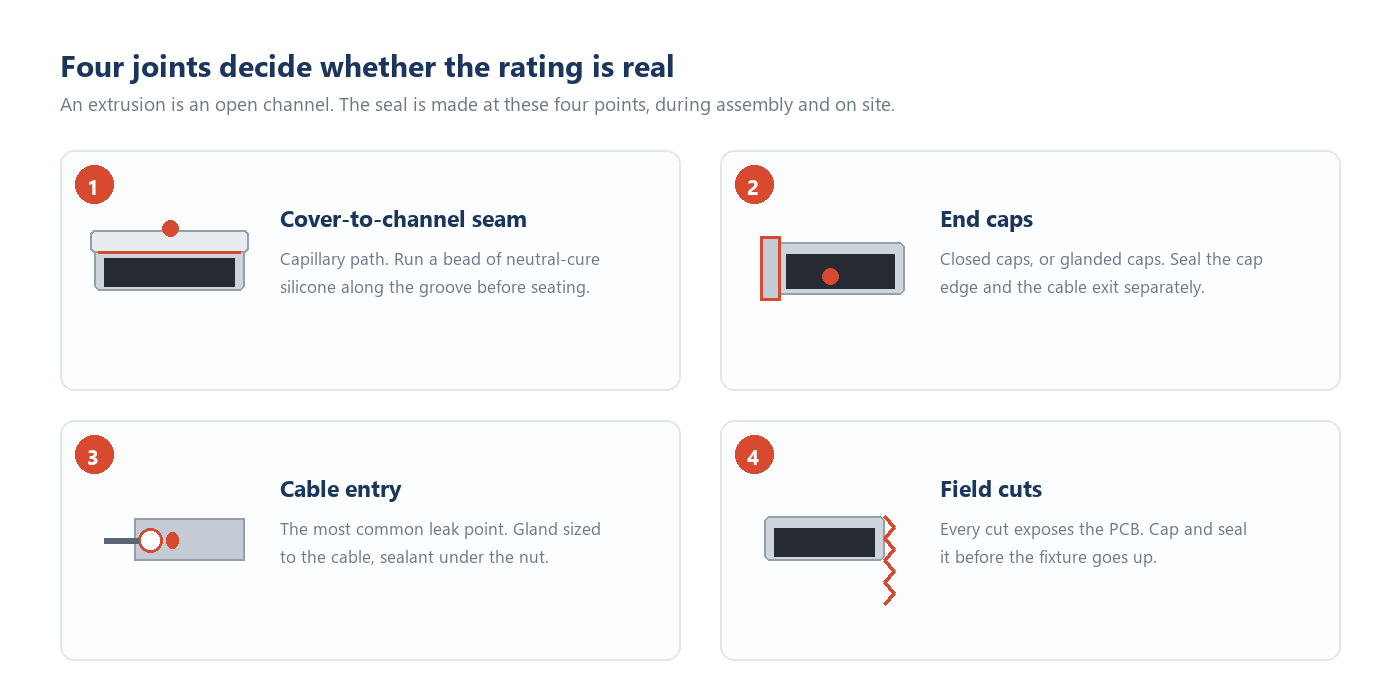
Every wet-area failure traces back to one of four joints. They are worth listing in the order they usually fail:
| Seal point | What goes wrong | What fixes it |
|---|---|---|
| Cover-to-channel seam | Water wicks along the groove by capillary action | Neutral-cure silicone bead along the groove before the cover is seated |
| End caps | Caps with cable holes let water straight in; friction caps leak under pressure | Closed caps, or glanded caps, plus sealant around the cap edge and the cable exit |
| Cable entry | The single most common leak point on any outdoor fixture | Cable gland sized to the cable (PG7/PG9/PG11), plus sealant under the gland nut |
| Field cuts | Every cut end exposes the PCB and its pads | Seal immediately with silicone end caps and a bead over the cut face |
Two notes that are easy to miss. Silicone sealant has to be neutral-cure; the acetic-cure grades used for glazing corrode the copper traces and the aluminum. And sealant needs to cure before the fixture is energized and before it sees rain — 24 hours is the usual figure, and shortcuts here stay invisible until the following season.
Why most outdoor failures are not IP failures
An IP rating tests two things: solids and liquids, under defined laboratory conditions. It does not test ultraviolet exposure, salt spray, thermal cycling, or condensation. A fixture can hold its IP65 rating through every test and still degrade in two years outdoors.
Four failure modes that sit outside the rating:
Drainage. Water that can run off does not need to be excluded. A run with a drip loop before the cable entry, and a mounting angle that sheds water away from the seam, survives conditions that would defeat a better-sealed but flat-mounted fixture.
Condensation. A sealed chamber that cycles between day and night temperatures pulls moisture out of the trapped air. It condenses on the coldest surface — usually the aluminum — and sits there. Venting with a hydrophobic breather, or leaving a desiccant sachet in a junction box, is more effective than another bead of silicone.
UV. The rating says nothing about it. Covers degrade, gaskets harden, and the seam that was tight in year one opens in year four. This is why the cover material matters as much as the seal — see our note on PC versus PMMA covers.
Salt and chemicals. Standard ingress tests use fresh water. Coastal and industrial sites need a marine-grade approach even when the IP number is high, because chloride attack is a corrosion problem rather than an ingress problem.
What we supply, and what we do not claim
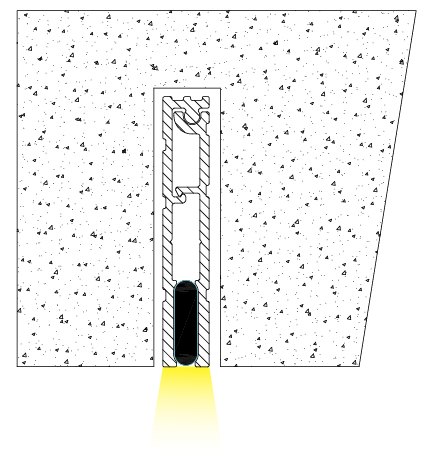
We publish 11 profiles designed for outdoor and wet-area use. They share three structural features: a gasketed or tight-fitting cover groove, closed end caps, and provision for a cable entry. Their real dimensions are listed here because the section is what constrains the sealing options:
| Modèle | Inner width | Outer W × H (mm) | Mounting | Cover |
|---|---|---|---|---|
| HL-BAPL067-F | 8 mm | 10.3 × 10.3 | coin | PMMA |
| HL-BAPL065-F | 9 mm | 11.4 × 12.2 | surface | PMMA |
| HL-BAPL066-F | 10 mm | 12.3 × 10 | surface | PMMA |
| HL-BAPL068-F | 10 mm | 16 × 16 | surface | PC |
| HL-BAPL071-F | 10 mm | 17.1 × 15.4 | surface | PC |
| HL-BAPL069-F | 11 mm | 17 × 14 | surface | PC |
| HL-BAPL070-F | 13 mm | 15 × 17 | surface | PC |
| HL-3030F | 19 mm | 30 × 30 | coin | none |
| HL-BAPL068 | 25 mm | 40 × 61 | suspendu | PC |
| HL-A041 | 8 mm | 94 × 45.6 | suspendu | none |
| HL-A081 | 61 mm | 75 × 60.4 | suspendu | PC |

Six of the eleven carry a PC cover and three a PMMA cover, which follows the outdoor logic above: PC where impact or UV-stabilized performance matters, PMMA on the small bodies where clarity is the point.
We do not claim an IP rating for these profiles. The rating is established by the assembled fixture and the site work, and quoting a number for an unassembled extrusion would misrepresent what has been tested. Our published IP68 certificate covers the LED neon range — HL-NT1615V24IP68 and the related NS and NV models, tested to EN 60529 — and does not extend to aluminum profiles. That scope is stated on the certificates page rather than left to inference.


Should you specify IP68?
Usually not, and the reasons are physical rather than commercial.
IP68 requires a fully sealed chamber — potting or compression glands — which adds weight, makes field servicing difficult, and traps heat around the strip. A sealed chamber that cannot convect runs hotter, and a hotter strip loses output faster, so the higher rating can shorten life if the thermal side is not re-checked.
IP68 belongs underwater. For a wall that gets rained on, IP65 with correct seals and drainage outperforms a badly installed IP68, because in both cases the failure mode is the joint, not the number.
FAQ
Related links
We design and supply LED aluminum profiles and linear lighting — over 200 profiles with matched diffusers and fittings, serving customers in more than 100 countries since 2007.
Engineering Lead · Reviews every dimension, extrusion section and installation step for technical accuracy before publication.
Translation and copy review — terminology, clarity and consistency of the English text.
Related reading
Send the strip width, the run length and the destination — we will match the profile, the diffuser and the fittings, and quote within 1 business day.
Start your inquiry