



Diffused vs Clear Cover: Light Quality and Glare
A clear cover passes most of the light and shows every diode. What that trade really costs on a glossy counter, and the three figures that decide it.
A clear cover passes most of the light and shows every diode. A diffused cover hides the diodes and gives up part of the output. That is the whole trade in one sentence — but it is not the sentence that decides most installations. What decides them is what the light lands on, because a clear cover over a polished surface does not just show dots. It shows them twice.
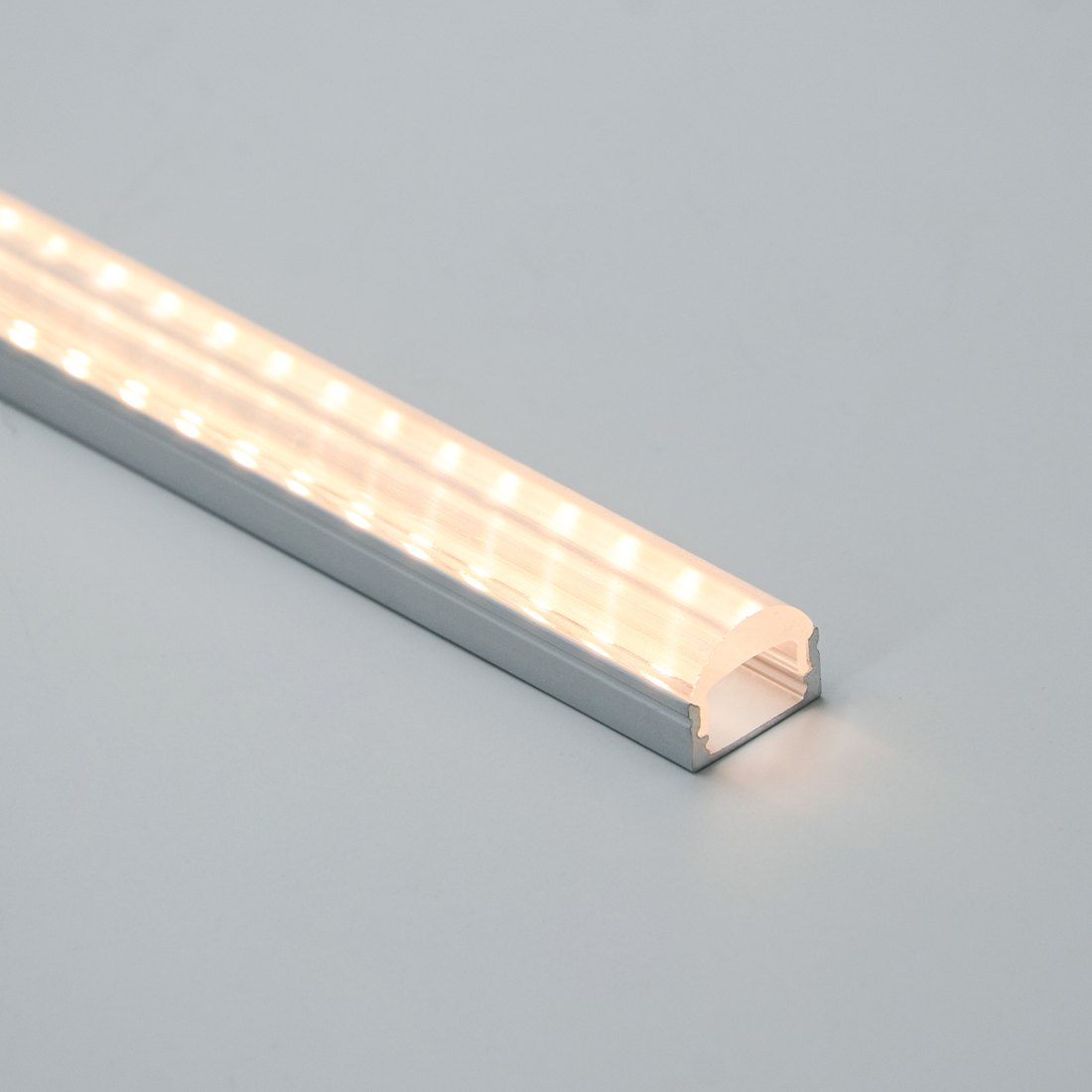
What does each cover do to the light?
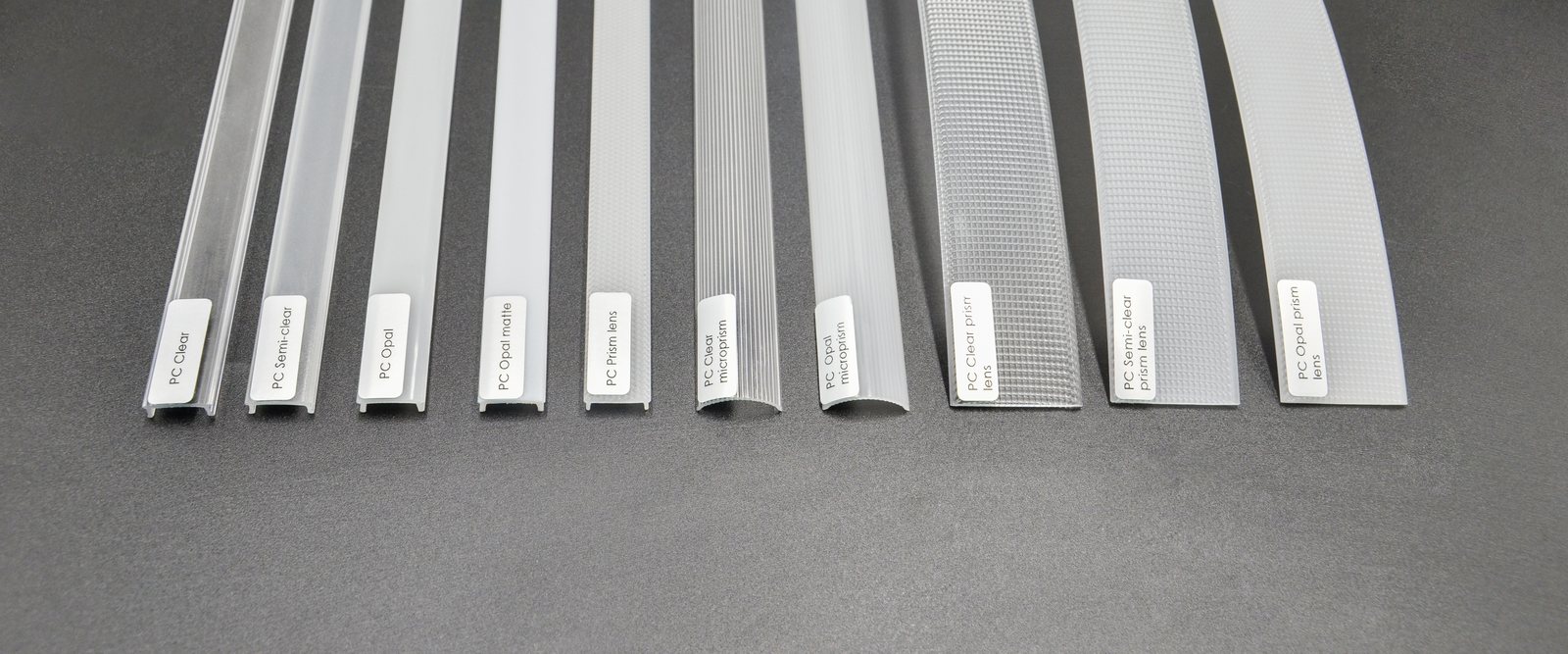
Three families, and the transmission figures are typical rather than exact — they move with material and thickness.
| Cover | Transmission | Diode visibility | Typical use |
|---|---|---|---|
| Clear | ~90–95% | Visible at close range | Hidden runs, indirect light, lens |
| Frosted / semi-clear | ~70–85% | Softened, still present | Task light, mid-range viewing |
| Opal / milky | ~60–70% | Not visible | Direct-view lines, polished surfaces |
The order is not a quality ranking. A clear cover is the correct specification for a cove where the strip is never seen; an opal cover is the correct specification for a kitchen counter you stand at every day. Choosing "the best one" without viewing conditions is how most cover mistakes occur.
Where do the dots actually come from?
Three variables, and the cover is only one of them.
Diode spacing. A strip with 60 LEDs per meter has gaps between emitters; at 120 or 160 LEDs per meter, the gaps are half or a third as wide. A COB strip has no gaps at all — it is a continuous phosphor layer.
Cavity depth. The distance between the diode and the cover allows light from adjacent emitters to overlap before it reaches the surface. A 5 mm cavity has almost no mixing distance; a 15 mm cavity has a lot of mixing distance.
Cover diffusion. Opal scatters hardest, frosted partially, clear not at all.
The useful consequence: a shallow body with an opal cover can still show dots, and a deep body with a frosted cover can be clean. Changing the cover without changing the depth often disappoints.

Why does a clear cover fail over polished stone?
Because the surface becomes a second light source.
A clear cover transmits the diodes almost unchanged, so the fixture is, optically, a row of point sources. Put that above polished granite, glazed tile, or a lacquered counter, and the surface reflects each point at the viewer. You do not see one row of dots — you see the row and its reflection, offset, at twice the apparent density.
This is the single most common complaint after a retrofit, and it is not a defect in the cover. It is a cover chosen for the wrong surface.
Two ways out: an opal cover (which removes the point sources), or a high-density or COB strip (which removes the gaps). Doing neither leaves a line that looks wrong from every standing position.
When is a clear cover the right answer?
Four cases, all of which share one property: the strip is not in the line of sight.
- Indirect cove lighting, where the light bounces off the ceiling plane rather than reaching the eye.
- A lens profile in which the prism shapes the beam and the cover is an optical element rather than a diffuser.
- A concealed reveal facing away from the room — under a lip, behind a baffle.
- Maximum output where nothing else works, accepting the dot pattern as part of the trade.
Notice that "it looks brighter in the sample" is not on the list. A sample viewed at 300 mm under office lighting tells you very little about a long run viewed from 2 m.
What about glare versus brightness?
These pull in opposite directions, and the honest trade is a choice rather than a solution.
A diffused cover reduces glare by spreading the source over a larger apparent area. That is why a milky line is comfortable to look at, and a clear one is not. What you give up is output — roughly a third of it, depending on the cover.
Three ways to keep both, in order of effectiveness:
- Increase density instead of reducing diffusion. A COB strip behind an opal cover is brighter and cleaner than a sparse strip behind a clear one.
- Increase the cavity depth. More mixing distance lets a less opaque cover still read as a line.
- Change the aim, not the cover. A lens or a corner profile that directs light across a surface rather than into the eye reduces glare without reducing output.
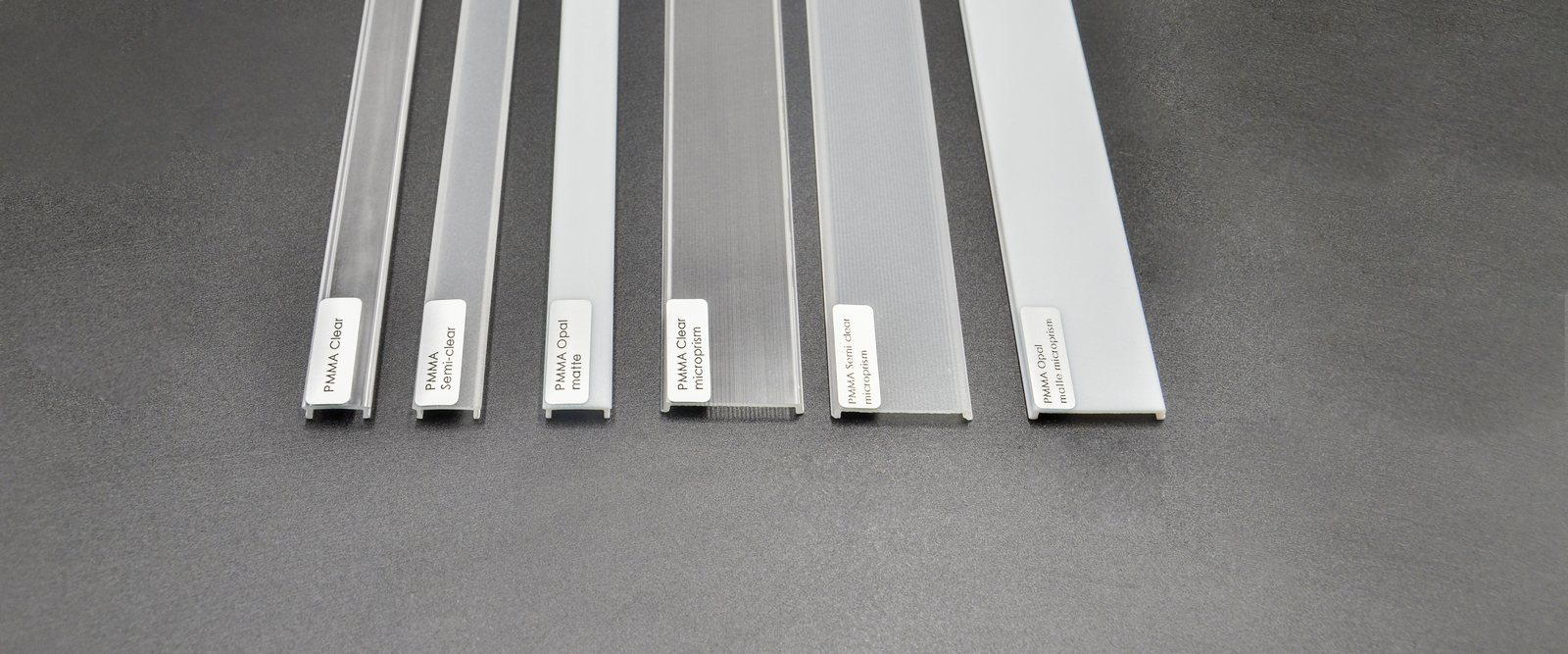
Does cover thickness matter?
Yes, in two directions at once, and the effect is smaller than the material choice.
A thicker cover diffuses more — more scattering volume between the diode and the surface — and transmits less. A 1.5 mm opal and a 2.5 mm opal of the same formulation are not identical: the thicker one is slightly softer and slightly dimmer.
What thickness does not fix is a cavity that is too shallow. Doubling the cover thickness adds a millimeter of mixing distance; doubling the cavity depth adds ten. If dots are the problem, depth is the lever, not thickness.
There is also a mechanical reason to care: a thicker cover is stiffer, seats more firmly in the groove, and resists bowing during long runs. On a wide body, a thin cover can lift in the middle between the clips, showing as a faint line of brighter light.
How do you choose?
Three figures, in this order:
- The viewing distance and angle. Is the strip within sight from where people stand or sit?
- The surface below it. Glossy or matte — a reflective surface doubles the dot problem.
- The strip's density and the cavity depth, which together decide whether a given cover can actually hide the diodes.
Then pick the least opaque cover that satisfies those three. Choosing the most opaque by default wastes light on runs that did not need it; choosing clear by default produces the reflection problem.
Our range lists the cover options for every section, and the lens collection is where the cover stops being a diffuser and becomes an optical element. For the material question — polycarbonate versus acrylic, impact versus optical clarity — that is a separate decision covered in the PC vs PMMA comparison.
Can I change the cover later?
Usually yes, and it is one of the advantages of an aluminum profile over a sealed fixture. The cover unclips from the groove; the strip stays. On a recessed or plastered-in body, access is the limit, not the cover itself.
Does a diffused cover reduce the strip's life?
No. It absorbs light, not heat, and it sits above the strip rather than against it. What shortens life is the thermal path between strip and body, which the cover does not touch.
Which cover is best for a bathroom mirror?
An opal or milky cover, without exception. A mirror doubles the source, so a clear cover shows the diodes twice — the same mechanism as a polished counter, with a worse geometry.
Is a black cover ever useful?
Yes, for appearance rather than light. A black diffuser reads as dark trim when the light is off, which suits dark ceilings and joinery. It transmits far less, so it is used where the line is decorative, and the output is not the point.
Do I need a cover at all?
For any exposed run, yes — both for the light line and for physical protection of the strip. A bare strip is exposed to dust, cleaning, and contact, and it has no diffuser to shape the output. Where the strip is genuinely concealed and protected, whether it has a clear cover or not makes little difference to the light.

We design and supply LED aluminum profiles and linear lighting — over 200 profiles with matched diffusers and fittings, serving customers in more than 100 countries since 2007.
Send the strip width, the run length and the destination — we will match the profile, the diffuser and the fittings, and quote within 1 business day.
Start your inquiry