



What End Caps and Connectors Do You Actually Need
Which accessories are structural and which are optional, why connectors only exist for 71 of 219 profiles, and the three omissions that stop an install.
Accessories usually arrive as a checklist: buy caps, buy clips, buy connectors. That is the wrong frame. Two of them are structural, and the run does not work without them. The rest are optional, depending on how you detail the line. The useful question is not what you can buy, but which omissions stop the install.
What do end caps do?
Three jobs, and only one is cosmetic.
They close the channel. An extrusion is open at both ends. Left open, dust and swarf collect inside, and the adhesive picks it up.
They define the IP boundary. This is the job people miss. A profile joins a water-resistant assembly only when the cover seats and both ends close. The cable end also needs a cap with a hole plus a gland, not a cap with a hole alone. We do not claim an IP rating for any bare profile, because someone creates the rating at this step.
They finish the run. A cut aluminum end shows the wall section, and in an anodized body it shows a bright edge. A cap hides it.
Two variants do the work: a closed cap for the far end, and a cable-entry cap for the fed end. You can use two closed caps and drill one on site, but it rarely looks neat.

What do connectors do, and why are they not universal?
A connector joins two lengths of profile into one continuous line. It is section-specific: it has to match the outer profile, the internal channel, and the position of the cover groove. A connector from one section will not bridge another.
Coverage is partial: 71 of 219 profiles list a connector, 148 do not.
The 148 are not defective. They fall into three groups.
- Short-run sections, such as cabinet and shelf bodies, where one bar covers the span.
- Narrow or shaped sections where a joint would be visible anyway, so the detail avoids joints.
- Sections where the joint is meant to be a shadow gap: two runs meeting with a deliberate break, which needs no connector at all.
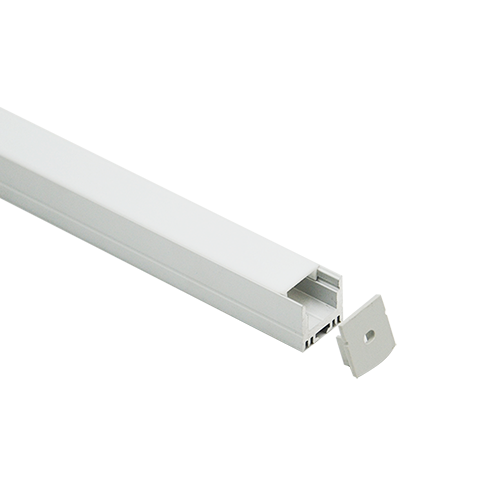
Why do suspended profiles almost always have one?
Because the fixing decides the run length, and the run length decides whether you need a joint.
| Монтаж | Profiles with a connector | Out of |
|---|---|---|
| Подвесной | 50 | 83 |
| Встраиваемый | 17 | 75 |
| Surface-mounted | 3 | 50 |
| Уголок | 1 | 11 |
The pattern is not arbitrary. A suspended run crosses a room, so it is long, and long means joints. A surface-mounted body is usually cabinet or shelf length, so it is short, and short means no joint. The slot you cut for it limits a recessed body.
That matters at the specification stage. If you need a continuous line longer than 4 m, check the connector before you commit to the section. Otherwise the joint becomes a site improvisation.
What are clips for, and when can you skip them?
A clip holds the body to the substrate. Three cases call for one.
- The body has no flange and no adhesive face, so clips are the only fixing.
- The substrate is not flat, so clips bridge the high points and take up the rest.
- The run is overhead or vertical, where adhesive alone is not reliable over time and a clip gives a mechanical fail-safe.
In a routed slot with a tight fit, clips may be unnecessary. On a smooth panel under a light load, adhesive can be enough. For overhead runs, specify clips regardless. The failure mode of adhesive is a run on the floor.
151 of 219 profiles list clips. The rest ship with a fixing built into the section, or suit a slot fit.

What does coverage look like overall?
| Accessory | Профили | Примечание |
|---|---|---|
| End cap | 210 of 219 | Two per run, minimum |
| PC diffuser | 180 | The default cover |
| Mounting clip | 151 | Essential for overhead |
| Suspension rope | 88 | 77 of the 83 suspended bodies |
| PMMA diffuser | 76 | Alternative cover where optics matter |
| Connector | 71 | Section-specific, not universal |
| Silicone diffuser | 10 | Only where the cover must bend |
The nine profiles without an end cap are almost all flexible bodies, where a silicone sleeve closes with a plug instead of a cap. Four older sections use a different closure.
What happens if you leave one out?
Three omissions stop an installation, in order of how often they happen.
No end caps on a wet-area run. The run looks finished but does not seal. Water enters at the open end, tracks along the channel, and reaches the strip at the lowest point.
No connector on a long run. The two bars meet end to end with no alignment. The joint shows as a step in the line, and the cover grooves do not line up. The diffuser either will not seat or sits proud.
No clips on an overhead run. Adhesive creeps under sustained load and warm conditions. The body drops, usually within a year, and takes the strip with it.
A fourth, less dramatic and more common: a connector ordered for the wrong section. It arrives, does not fit, and the project waits for a second delivery.

What about suspension ropes?
Of the 83 suspended profiles, 77 list a suspension rope. The other six use a different ceiling fixing, so the rope is not the right question for them.
The rope determines three things, and only the first is obvious.
- The drop. The rope sets the distance from slab to body, and that sets the finished clearance.
- Whether the body can hold level. A suspended run of any length needs height and level adjustment.
- Where the ceiling fixing lands. The anchor has to fix into a slab, a joist or a cast-in insert, not the plasterboard.
You check the finished clearance against the working plane, not the floor. Slabs are not flat, so a rope with only a height adjuster leaves a run that is straight in section and wavy in elevation. On a retrofit with no access above, the fixing constraint alone can decide the whole detail.
If the ceiling fixing stays open, do not order the body yet. The rope is the cheapest part of the order and the one that most often comes back.
How do you build the list before ordering?
Five questions, in this order.
- How many open ends? Two per continuous run, plus one per break.
- Which end feeds the run? That end needs a cable-entry cap, and a gland in a wet area.
- Will any run exceed the longest bar available? If yes, you need a connector, and you need to confirm the section supports one.
- Is anything overhead or vertical? If yes, clips.
- Is anything suspended? Then the rope and the ceiling fixing belong in the order.
Answer those five and the accessory list writes itself. Our range lists the accessories for every model, and the suspended group is where the rope and connector questions usually come up.
Do I need end caps if the run is indoors and dry?
Yes, for two reasons unrelated to water: dust collects inside the channel, and the cut edge stays exposed. A cap closes both, and it takes a minute to fit.
Can one connector join any two profiles?
No. It is made for a specific section: outer shape, channel, cover groove. Two profiles that look similar in a photograph are often different where the connector fits.
What is the difference between a clip and a bracket?
A clip holds the body against a surface. A bracket holds it away from the surface, or at an angle, and suits suspended or adjustable runs. They are not interchangeable.
How many clips per meter?
Enough that the body does not sag between them, which depends on section stiffness. A shallow body needs them closer together than a deep one. A rigid section on a flat substrate may need few.
Can I make a corner without a corner connector?
By mitering both bars at 45° and butting them. It works, and most trimless corners are done that way. The cut has to be accurate; no connector absorbs the error.
See also: What a profile does, and the full range, where accessories are listed per section.

Мы разрабатываем и поставляем алюминиевые профили для светодиодного освещения и линейные светильники — более 200 моделей профилей в комплекте с подходящими рассеивателями и арматурой. С 2007 года мы обслуживаем клиентов в более чем 100 странах.
Engineering Lead · Reviews every dimension, extrusion section and installation step for technical accuracy before publication.
Рекомендуемые материалы


Укажите ширину полосы, длину отрезка и место назначения — мы подберем профиль, диффузор и соединительные элементы и предоставим коммерческое предложение в течение 1 рабочего дня.
Отправьте запрос