



What to Send a Supplier for an Accurate Quote
Three numbers decide the quote; everything else is a modifier. What to send so it comes back right the first time, and what causes the second email.
Most profile quotes come back wrong for one reason: the inquiry did not contain the three numbers the quote depends on. Everything else — finish, accessories, packing, delivery — modifies those three. Get them right, and the first reply is usually usable; leave them out, and the correspondence takes a week.
What are the three numbers?
The strip's PCB width. This decides which sections are possible at all. A 12 mm strip rules out every body whose channel is narrower than 12 mm, which is a large part of the range.
The length you need, per run. Our profiles are supplied in any length up to 4 m, cut to your size — so the useful figure is the cut length, not a request for "standard lengths".
The quantity, in meters or in pieces, is stated clearly. "A few hundred meters" and "300 m in 40 pieces of 7.5 m" produce very different answers on schedule and packing.
Those three narrow 219 profiles to a handful. Everything after that is a modifier, and modifiers are easy to add later — the base numbers are not.
What else changes the answer?
Five modifiers, in the order they affect the quote:
| Modifier | Why it matters |
|---|---|
| Mounting method | Decides which family — recessed, surface, suspended, corner |
| Cover | Clear, frosted, opal, or lens; changes the light and the part number |
| Finish | Anodized or powder-coated: a standard color and a matched color are on different schedules. |
| Accessoires | End caps, clips, connectors — a connector only exists for some sections |
| Delivery point | Affects packing and freight, not the profile |
Two of these are more consequential than buyers expect.
The cover is not a free choice: a section may accept several, and each one changes how the line looks. Specifying "with diffuser" is the most common incomplete line in an inquiry.
The connector may not exist for the section you chose. 71 of our 219 profiles list one; if a run needs joining and the section has none, that is a conversation to have before the order, not after.
What does a usable inquiry look like?
Short, and specific. This is enough for us to quote without a second email:
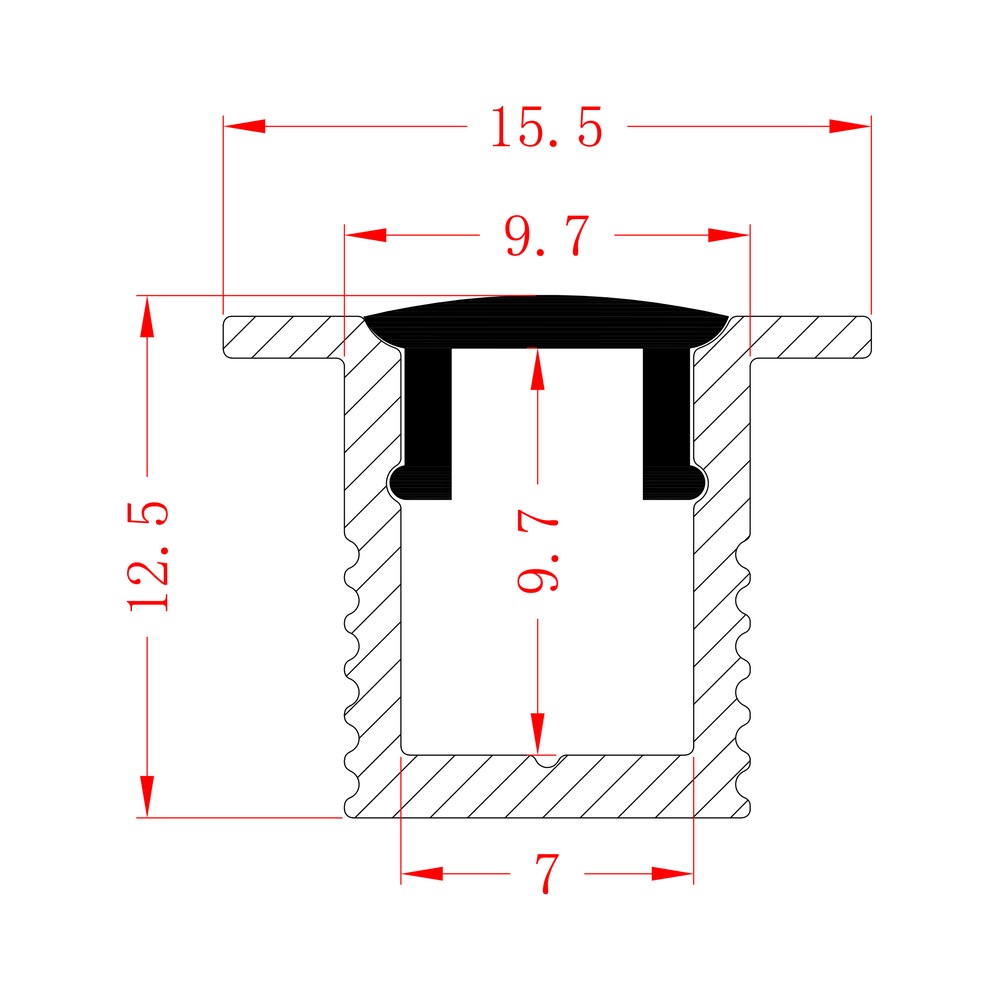
Section: HL-A065 (or: recessed, 15.5 × 12.5 mm, 6 mm strip)
Strip: 6 mm PCB, 12 W/m
Length: 2.4 m × 6 pieces, 1.8 m × 2 pieces
Cover: opal PC
Finish: black anodized
Accessories: end caps, clips
Delivery: Hamburg, by sea
Quantity basis: meters
Seven lines. Each one removes a question that would otherwise come back.

What if you don't have a section in mind?
Three alternatives, in order of usefulness:
Send the strip and the constraint. "6 mm PCB, 12 W/m, going into a 15 mm deep slot in a plasterboard ceiling" is enough to name three or four sections. This is often faster than browsing a catalog, because the constraint does the filtering.
Send the application. A cabinet underside, a mirror, a stair nosing, a cove — each points at a family, and the family narrows quickly.
Send a photo with a scale. Useful for a retrofit where an existing profile has to be matched, and it works — provided something in the frame gives the size. A photo without a scale cannot be quoted from.
What does not work as an inquiry: "please send your catalog for LED profiles". There is no product in it.
What usually causes the second email?
Four things, and all four are avoidable:
"Standard length" — we cut to your size up to 4 m, so there is no standard to quote against. The reply has to ask what length, which adds a day.
No PCB width — the supplier can quote a section, but cannot confirm it fits. The reply offers three sections and asks which strip, which is a round trip.
Quantity in the wrong unit — "500" could be pieces, meters, or kilograms. On a profile, those differ by an order of magnitude.
No delivery point — a quote without a destination is a figure, not a delivered figure. If the inquiry says where it is going, the reply can be complete.
What should you not send?
Three things that slow it down rather than speed it up:
A request with no specification. It produces a range of options, not a quote, and the range is too wide to plan against.
A 3D file with no section drawing. A STEP file is useful for a custom die; for a catalog section, it tells the supplier less than a dimensioned drawing, because the critical numbers are not annotated.
A photo of a competitor's product asking "the same". "The same" is not a specification. The section may be close, but the channel, the groove, and the wall thickness are what the order depends on — and they are not visible in a photo.
What comes back, and when?
Two timelines, and the inquiry should say which one applies:
Stock items ship in about 3 to 5 days. The quote depends only on the modifiers above — finish and accessories.
Custom sections take 15 to 30 working days because a die must be designed, cut, tested, and approved. If the inquiry might become a custom section, say so early: it changes the whole conversation from "which profile" to "which geometry".
MOQ is 20–100 m depending on the section and the finish. Stating an approximate quantity allows the reply to confirm whether the order falls within that band, rather than quoting something that cannot be produced.
How do you compare two replies?
On the same basis, or the comparison is meaningless. Four lines to check:
- Same section — the model number, not "similar size".
- Same cover — opal and clear are different products.
- Same length and quantity basis — meters against pieces hides a factor.
- Same delivery term — ex-works and delivered are not comparable.
If two replies differ by more than the modifiers can explain, one of them has assumed something. The useful question is not "why is yours higher" but "what did you assume" — and a supplier who can answer that is the one worth keeping.
Our range lists the three numbers for every profile, so the first line of the inquiry can be answered before writing it. The service process page sets out how a custom section proceeds when no catalog profile fits.
Can I get a quote from a photo of my existing profile?
For a match, yes — with a scale in the frame and the strip width. For a firm quote, a dimensioned section is needed, because the channel and groove are what the quote and the fit depend on.
Do I need to specify the alloy?
Not usually — our range is 6063 throughout. If a project specification calls for a different alloy or a temper on the certificate, say so, because it changes what can be supplied.
What is the smallest quantity you quote?
MOQ is 20–100 m depending on section and finish. Below that, a sample length is usually the practical route rather than a production order.
How long is a quote valid?
Ask — and ask what it is based on. A quote on anodized stock and a quote on a matched powder color have different sensitivities to scheduling.
Can I mix several sections in one order?
Yes, and it is common in projects with different details. List them separately with the quantity for each so that the schedule can be confirmed per section rather than averaged.

We design and supply LED aluminum profiles and linear lighting — over 200 profiles with matched diffusers and fittings, serving customers in more than 100 countries since 2007.
Send the strip width, the run length and the destination — we will match the profile, the diffuser and the fittings, and quote within 1 business day.
Start your inquiry