



MOQ and Lead Time: How They Affect Your Project Schedule
MOQ is a band, not a number, and there are two lead times. How each one behaves, and the three assumptions that most often move a delivery date.
Two numbers get quoted in every inquiry, and both are usually treated as fixed. They are not. MOQ is a band that depends on the section and the finish, and lead time is a different figure depending on whether the profile already exists. Planning against a single number is how a programme loses a week without anyone making a mistake.
What is the MOQ, and why does it vary?
Our MOQ is 20-100 meters, depending on the section and finish.
The band exists because three things set the minimum, and they do not move together:
The section. A stock profile with an existing die can be run in short lengths; a section that has to be set up on the press carries a practical minimum regardless of what the buyer wants.
The finish. Anodizing and powder coating are batch processes. A standard color joins a batch already scheduled; a matched color needs a batch to accumulate, and that sets a floor no order size can argue with.
The order as a whole. Several sections in a single order can share setup and finishing, which often reduces the effective minimum for each line.
Two practical consequences:
- Ask what the minimum is for the specific section and finish, not for "profiles" in general. The answers for a stock silver body and a matched black body are different.
- Below the minimum, a sample length is the route, not a reduced production order. It gets the section into the project without pretending the economics have changed.

What are the two lead times?
Stock items: about 3-5 days. The profile exists; the finish is standard; and the work is cutting and packing. This is the figure for a project that has settled on a catalog section.
Custom sections: 15 to 30 working days. A new die must be designed, cut, tested, corrected, and approved before production starts. The spread inside that range is set by the complexity of the section, not by the order size.
The two are not a fast option and a slow option for the same thing. They are different products: one exists, one does not yet.
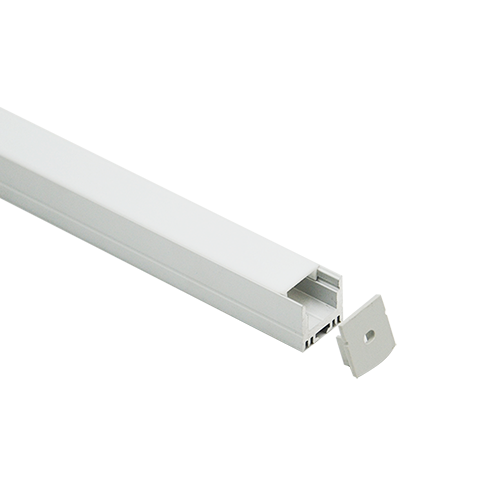
Where does the time actually go on a custom section?
Four stages, and only one of them is production:
| Stage | What happens | Who holds it up if it slips |
|---|---|---|
| Die design and cutting | The tool is made to the drawing | Die workshop |
| Trial and correction | A length is run and measured; corrections made | Die workshop and you, on approval |
| Production | The section is extruded and cut | Press schedule |
| Finishing | Anodizing or coating | Batch schedule |
The stage that most often slips is trial and correction, and the reason is usually approval rather than manufacturing: a trial length is sent, and it sits waiting for someone to say yes. On a 20-working-day program, a three-day approval delay is 15% of the schedule, and it happens after the money has been spent on the die.
How do you build a schedule around these figures?
Work backward from the installation date and enter the approval decisions as tasks with dates.
- Installation date — the anchor.
- Delivery to site — allow for transport and clearance, which is not part of the lead time.
- Production and finishing — 15 to 30 working days for a custom section, 3 to 5 days for stock.
- Sample approval — for a custom section, this sits inside the 15–30 days, and it needs a named person and a date.
- Drawing sign-off — before the die is cut, and the point at which changes become expensive.
Written as a chain, it usually shows one thing: the decision dates are earlier than the team expects, and they are decisions, not durations. A program that plans for 25 working days but not for the three days of internal approval misses by three days.
What can move a date?
Three assumptions, all common, all capable of adding a week:
"Standard length". Our profiles are supplied in any length up to 4 m, cut to your size — so the cut list has to exist before the order is placed. A cut list that arrives after order confirmation stops cutting, not extrusion.
"Standard color". A color not in the current batch schedule waits until the next one. The lead time quoted for a stock section assumes a standard finish; a matched color is a different line on the schedule.
"We will confirm the accessories later." End caps and clips for a stock section are usually available; for a new section, they are tooled after the die is proven, which puts them behind the extrusion rather than alongside it.
There is a fourth, less obvious one: a change after the die is cut. A change to the channel or the aperture is a die correction, and a correction takes the same order of time as the original tool. That is why the drawing sign-off matters more than any other date in the chain.
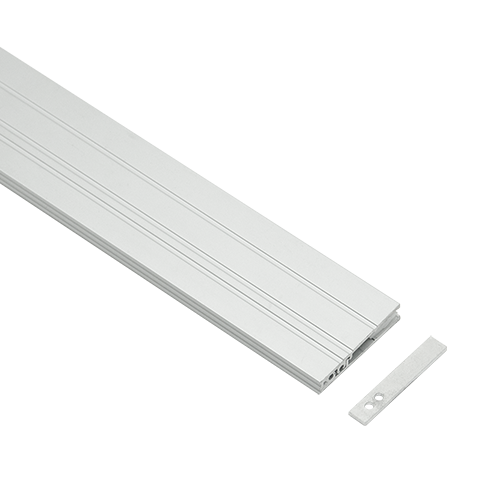
How do you protect a program?
Four habits, in order of effect:
Settle the section before the drawing is finalized. A catalog section that is 2 mm narrower than ideal is usually a better program than a custom section that is exact — because the catalog one ships in days. Check the range before commissioning a die.
Put the approval dates in the program, with names. A trial length that nobody is waiting for is a week.
Order the accessories with the profile, not after. On a custom section they follow the die; on a stock section they are the item most often short.
Keep a spare length. One extra bar per long run is cheap against a site delay, and it covers the cut that goes wrong.
What about warranty and after-sales?
Our profiles carry a 3-year warranty. It is worth reading what it covers before the order rather than after a claim: finish performance, dimensional conformity and manufacturing defects are different categories, and a warranty that covers one is not a warranty that covers all three.
How do these numbers interact with quantity?
Loosely, and not in the direction people expect:
- Above the MOQ, lead time does not shorten. A larger order does not make a die faster.
- Below the MOQ, lead time does not lengthen — the order is either accepted or routed to a sample.
- The finish, not the quantity, is what stretches a schedule. A matched color on a small order is the worst combination for a date because it requires both a batch and a slot.
Our range is 219 stock sections, which is the fastest route for most projects. Where none fits, the service process page sets out the custom path and what it needs from you.
Is the MOQ per section or per order?
Per section, in practice, and it also depends on the finish. Ask for the figure corresponding to the specific section and the color you intend to order.
Can I order below the MOQ for a sample?
Yes — as a sample length rather than a production order. It is the normal route for a first project with a new section, and it lets the section be tested in the actual detail.
Does a larger order ship faster?
No. Production and finishing are scheduled by process, not by volume. A larger order may take longer to run, not shorter.
What if my installation date is inside the custom lead time?
Then the choice is a stock section, a phased installation, or a later date. A die cannot be compressed much below the 15-day end of the range without a reason, and a program built on the assumption that it can is a program with no margin.
Does the 3-year warranty start at delivery or at installation?
Ask for it in writing on the order. The difference matters on a project where material is delivered months before it is installed.

We design and supply LED aluminum profiles and linear lighting — over 200 profiles with matched diffusers and fittings, serving customers in more than 100 countries since 2007.
Send the strip width, the run length and the destination — we will match the profile, the diffuser and the fittings, and quote within 1 business day.
Start your inquiry