



PC vs PMMA Diffuser: Which to Choose for Your Project
PMMA for optical longevity, PC for mechanical exposure, silicone only where the cover has to bend. Compares transmission, impact, UV yellowing and fire rating, and explains why 57 of our profiles can take either cover.
Choose PMMA when the cover stays on show and has to remain clear for years: architectural, retail, anything with an optical job. Choose PC where impact and fire behavior matter more than optics: public spaces, low-level runs, transport. Choose silicone only when the cover has to bend.
That is the short answer. The longer one matters, because most comparison tables stop at a transmission figure and a "250 times stronger than glass" claim. Neither decides the specification on its own.
What differs between the two materials?
The numbers below are typical published values for extruded sheet and diffuser stock, not measurements from our workshop. They vary by grade and by how much diffusing agent the maker loads into the resin. Treat them as a ranking, not a specification.
| Property | PMMA (acrylic) | PC (polycarbonate) |
|---|---|---|
| Light transmission | ~92% (clear grade) | ~85–89% |
| Impact resistance | Low. Brittle, cracks under point load | High: roughly 250× glass, ~30× PMMA |
| Service temperature | ~90 °C | ~135 °C |
| UV stability | Naturally UV stable; resists yellowing for years | Needs UV stabilization to avoid yellowing |
| Fire behavior | HB, burns | UL94 V-2 to V-0, self-extinguishing |
| Cold bending | Cracks; must be formed hot | Bends cold |
| Superficie | Harder, glossier, scratches show | Softer, easier to scuff |
| Typical use | Architectural, retail, optical | Public, outdoor, high-impact, industrial |
Two of those rows get quoted far more often than anyone applies them: impact resistance and UV.
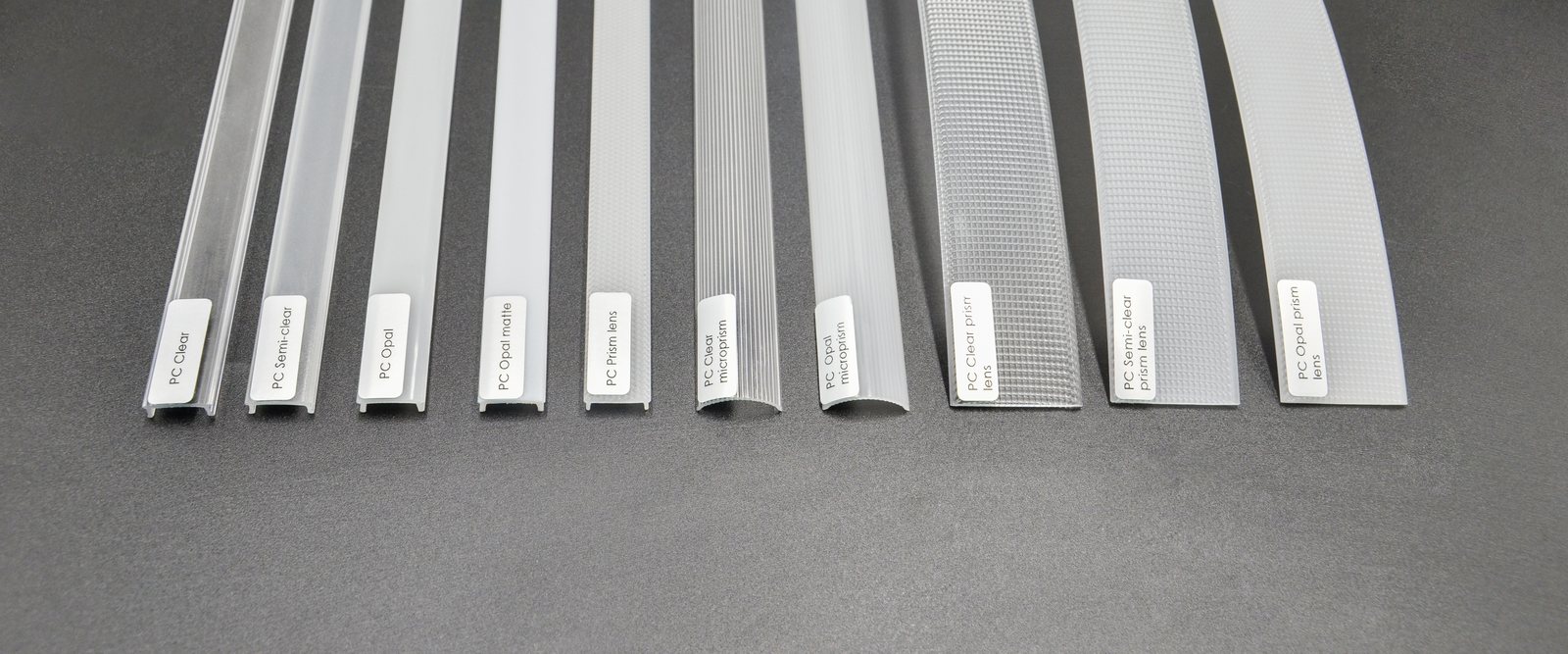
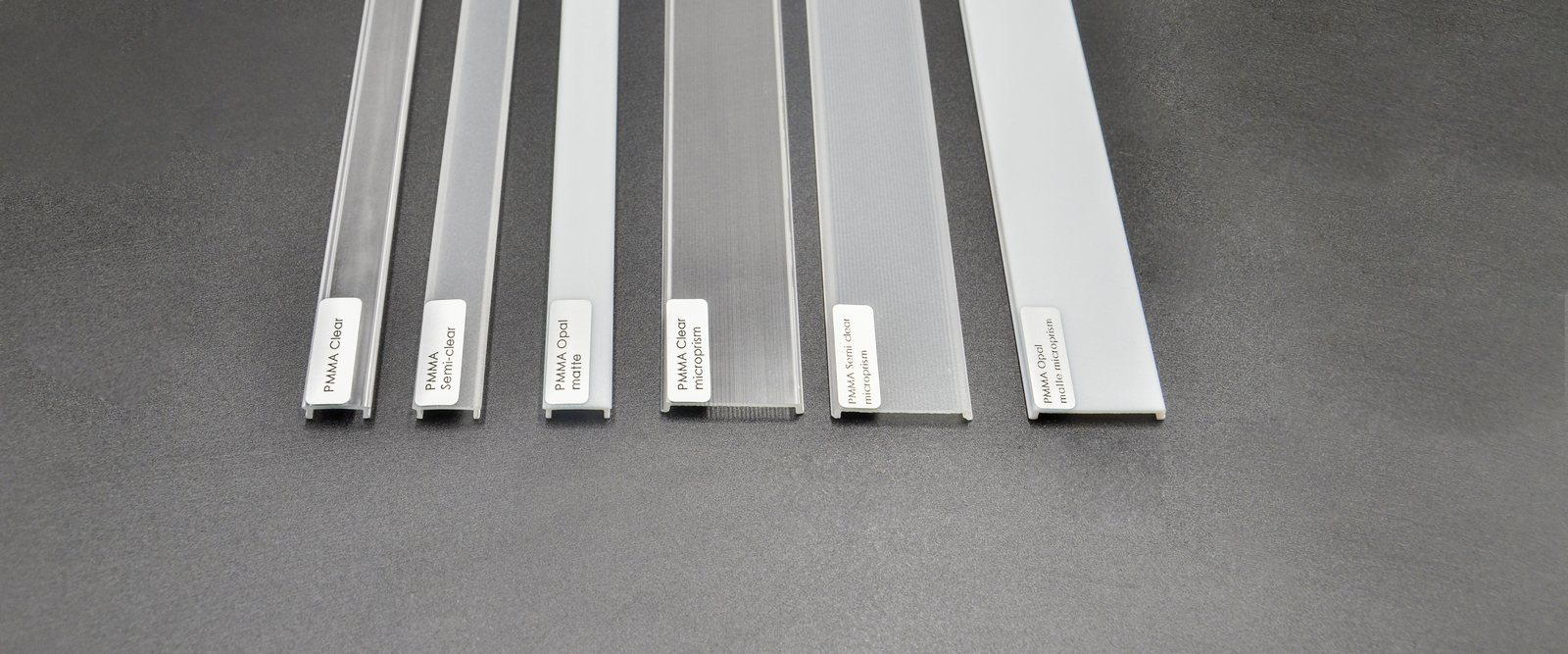
Why impact resistance matters less than the datasheet suggests
A cover sitting in an aluminum channel is not a free-standing panel. Two walls of the extrusion capture its edges, and the body supports the diffuser along its full length. The aluminum takes any load applied to the fixture. In a recessed or surface-mounted run, the cover is a lens, not a structural part.
That changes the comparison. PC wins decisively in three situations.
- Low-level installations: stair nosings, floor-recessed runs, anything within reach of a trolley, a boot or a cleaning machine.
- Public and sports spaces, where an object may strike the fixture, not a person.
- Fixtures that must self-extinguish. PC carries a V-rating that PMMA does not.
In a ceiling cove or a suspended office run, the impact argument mostly disappears. What remains is optical clarity and long-term color, and there PMMA wins.
Stated plainly, PC is not the better material. It is the material to choose when the fixture faces mechanical risk. We can supply most published profiles, 180 of 219, with a PC cover, because that is what projects ask for by default.
What does UV do to a cover?
This is where the industry contradicts itself, and the contradiction is worth naming.
Most comparison pages state, correctly, that PMMA resists UV yellowing far better than PC. Several of the same pages then recommend PC for outdoor use. Both statements are defensible, but only if you separate the two risks.
| Outdoor exposure | Dominant risk | Sensible cover |
|---|---|---|
| Facade, canopy, exposed run, no impact risk | Yellowing, clarity loss over years | PMMA, or a UV-stabilized PC grade |
| Low level, walkway, public realm | Impact, vandalism, cleaning damage | UV-stabilized PC |
| Coastal or industrial atmosphere | Surface degradation, salt | UV-stabilized PC; check the alloy finish too |
A standard PC cover without UV stabilization will yellow, and the change shows against a white ceiling within a few years. A UV-stabilized PC grade pushes that out considerably but does not match the natural stability of PMMA. So the rule is simple. PMMA for optical longevity, PC with a UV-stabilized grade for mechanical exposure. If a project needs both, that is a specification conflict worth raising with the client, not averaging away.
Can the same profile take either cover?
Often yes, and this is more useful commercially than any material datasheet.
In our range, 57 of 219 profiles list both a PC and a PMMA diffuser as available components. A further 123 list PC only, 10 use a silicone diffuser, and 14 are structural bodies with no cover at all.
| Cover availability | Perfiles | What it means |
|---|---|---|
| PC or PMMA | 57 | Same body, cover chosen per project |
| PC only | 123 | Cover geometry tied to PC |
| Silicona | 10 | Flexible or soft-glow runs |
| No cover | 14 | Structural or bare-channel bodies |
The practical value is that a cover swap does not need a new extrusion die. If a client moves from a matte interior scheme to an exterior application on the same body, you change a component, not a tool. It also makes samples cheap: order one body and two covers instead of two bodies.
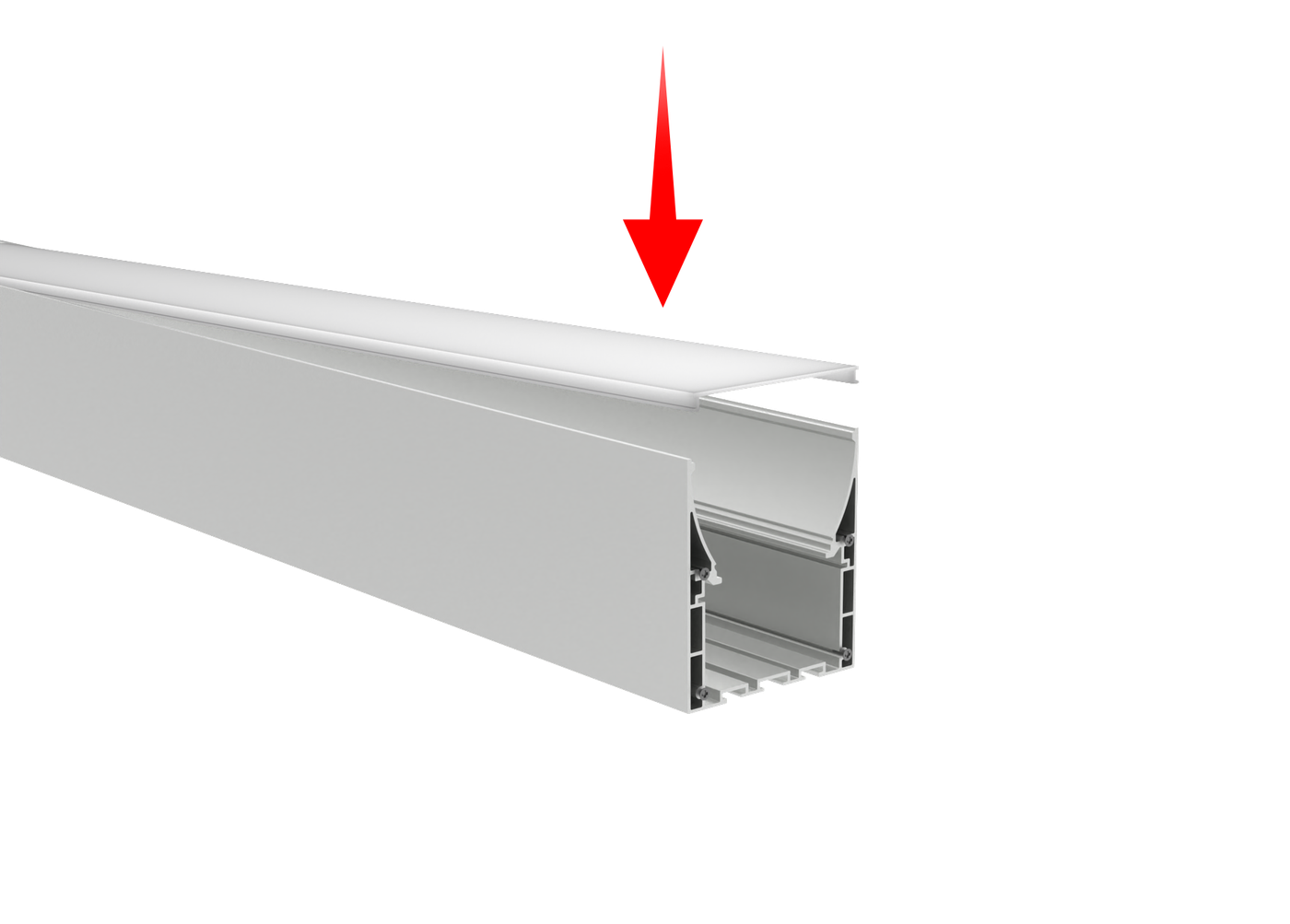
What a cover swap does not do is change the clip geometry. The diffuser has to match the groove it snaps into. So "PC or PMMA" applies only where the body lists both, not across the range.
Why our lens profiles are PMMA only
Six profiles in the range carry a lens, not a plain diffuser.
| Modelo | Inner width | Outer W × H |
|---|---|---|
| HL-BAPL002L | 12 mm | 17 × 13.7 mm |
| HL-BAPL034 | 16 mm | 19.6 × 17.8 mm |
| HL-BAPL012 | 17 mm | 19.6 × 16.2 mm |
| HL-BAPL059 | 17 mm | 20.3 × 15.5 mm |
| HL-A032 | 25 mm | 47.8 × 14 mm |
| HL-A033 | 25 mm | 31.8 × 17.2 mm |

All six use a PMMA cover. That is not a preference. A lens has to hold a defined cross-section along its whole length to send light where it is aimed. PMMA is stiffer, holds its form, and starts with higher transmission, which is what a lens needs. The higher haze and greater flexibility of PC work against both.
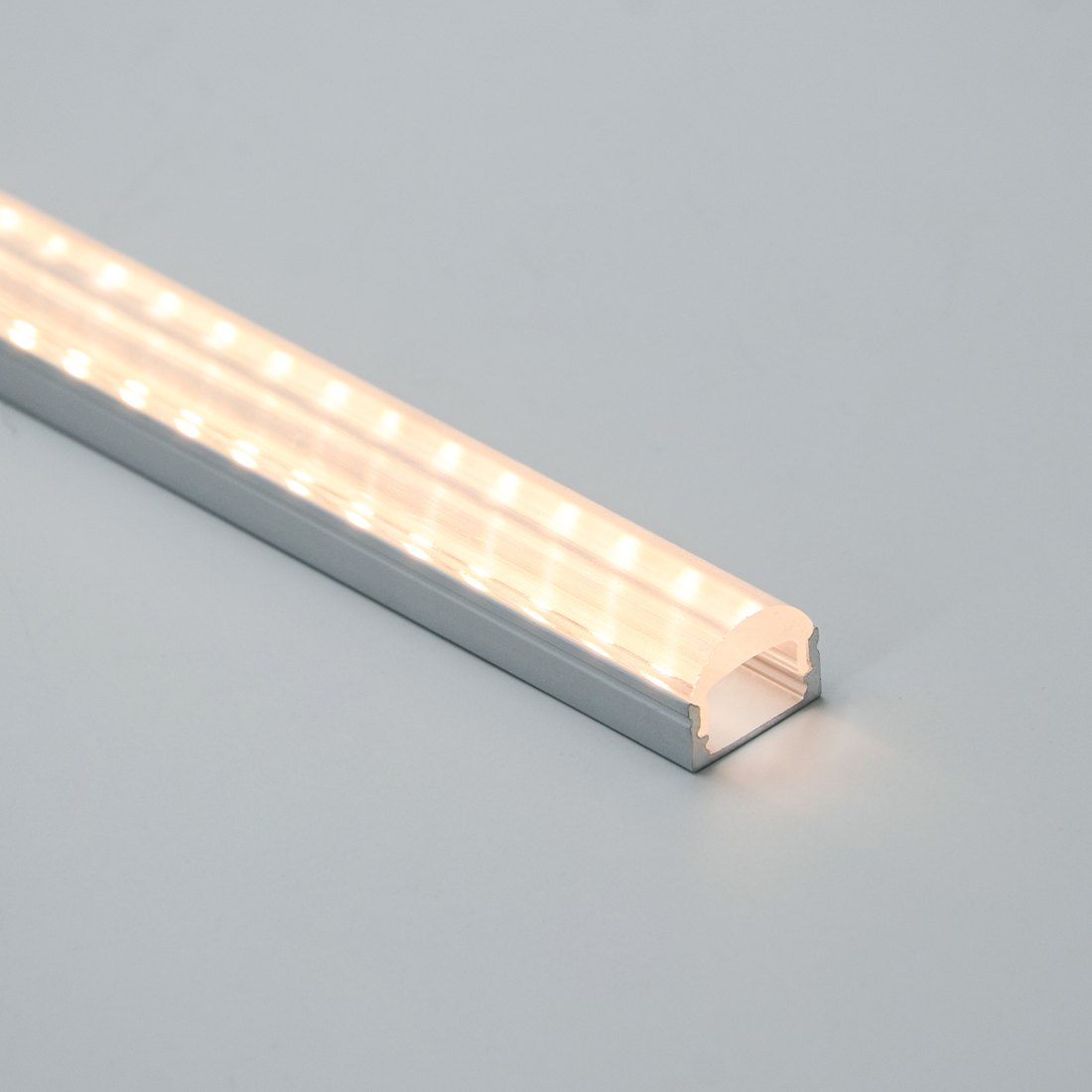
If a project specifies a lens, the cover material is already decided. See the lens profile group for the full list.
Where silicone fits
Ten profiles use a silicone diffuser. It is the right answer in a narrow band of cases. One is a bendable body where a rigid cover cannot follow the curve. The other is a run where the light has to be soft, with no visible structure at all.
It is the wrong answer where the cover has to be dimensionally stable, clip in with a defined snap, or survive cleaning abrasion. Silicone also attracts dust, which matters on a downward-facing run above a work surface.
What this means when you specify
Four questions, in order.
- Is the fixture within reach? If yes, start from PC.
- Will anyone look at the cover for a decade? If yes, start from PMMA.
- Does the body list both covers? Check the components, not the product title. Only 57 of 219 do.
- Is there a lens in the section? Then the answer is PMMA and there is nothing to decide.
The one thing to avoid is specifying a cover from a transmission figure alone. A 92% clear cover and an 85% opal cover are not comparable numbers. The opal grade does a different job, and the figure reflects the diffusing agent, not the quality of the material.
PREGUNTAS FRECUENTES
Is PMMA stronger than polycarbonate?
No. PC is substantially tougher: roughly 250 times glass and around 30 times PMMA in impact tests. PMMA is harder on the surface, so it resists scratching better, but it cracks under point load or bending stress.
Which one yellows less outdoors?
PMMA. It is naturally UV stable and holds clarity for years. PC requires UV stabilization, and an unstabilized grade will visibly yellow against a white ceiling within a few years. If a project uses PC outdoors, confirm the grade is UV stabilized.
Can I put a PMMA cover on a profile supplied with PC?
Only if that body lists both. 57 profiles in our range do. The cover has to match the clip groove it snaps into, so availability is decided per body, not by material preference.
Does the cover change the color of the light?
It changes how people perceive the light. A diffusing cover spreads output and softens edges. A clear cover leaves the diodes visible. The effect depends on the pitch of the strip, the cavity depth and the cover together. It is not a property of the material alone.
Is there a third option besides PC and PMMA?
Yes: silicone, and PVC on cheaper imports. Silicone is used on bendable bodies and soft-glow runs, and 10 profiles in our range use it. Untreated PVC is the weakest of the four outdoors, and it is the usual cause of a cover turning yellow within two years.
We design and supply LED aluminum profiles and linear lighting — over 200 profiles with matched diffusers and fittings, serving customers in more than 100 countries since 2007.
Engineering Lead · Reviews every dimension, extrusion section and installation step for technical accuracy before publication.
Related reading
Send the strip width, the run length and the destination — we will match the profile, the diffuser and the fittings, and quote within 1 business day.
Start your inquiry