



What Is 6063-T5 Aluminum and Why Does It Matter? People often use
6063 is the alloy; T5 is the temper. One decides how it extrudes, the other decides whether it bends. How to verify the pair before you order.
"6063-T5" as one word, usually as a compliment. It is two specifications. 6063 is the alloy — what the metal is made of — and T5 is the temper — what was done to it after extrusion. The alloy decides how well it takes a complex die; the temper decides whether the finished profile bends or cracks.
What does 6063 mean?
It is an Al-Mg-Si alloy — aluminum with magnesium and silicon, and very little else. That lean composition is the point: it extrudes fast, fills intricate dies, and comes out of the press with a smooth surface.
Those three properties are why the alloy dominates architectural work. Window frames, curtain walls, handrails, heat sinks and LED profiles are all 6063, not because it is the strongest aluminum available — it is not — but because it is the easiest to form into thin-walled, high-tolerance shapes with a finish good enough to anodize.
For a profile, the practical consequences are:
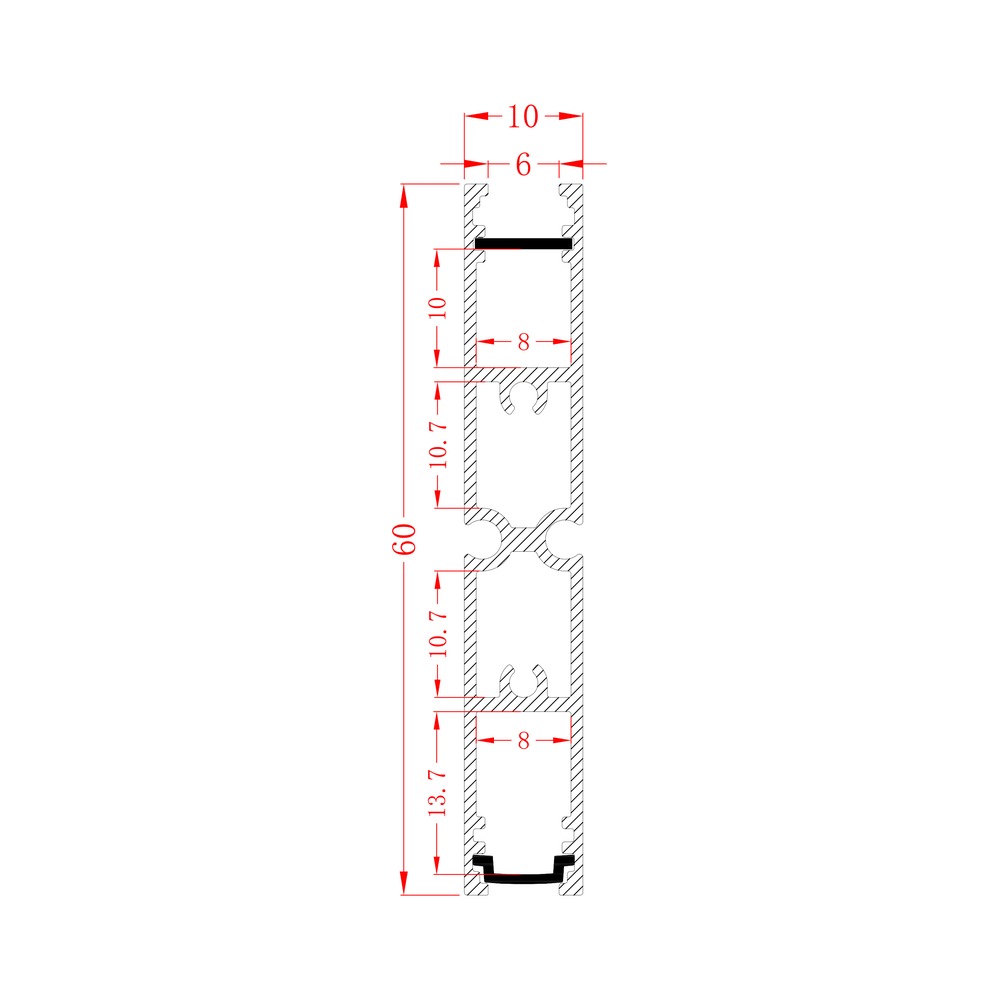
- Thin walls are possible. A 1.0–1.2 mm wall with a clean face is routine in 6063 and difficult in stronger alloys.
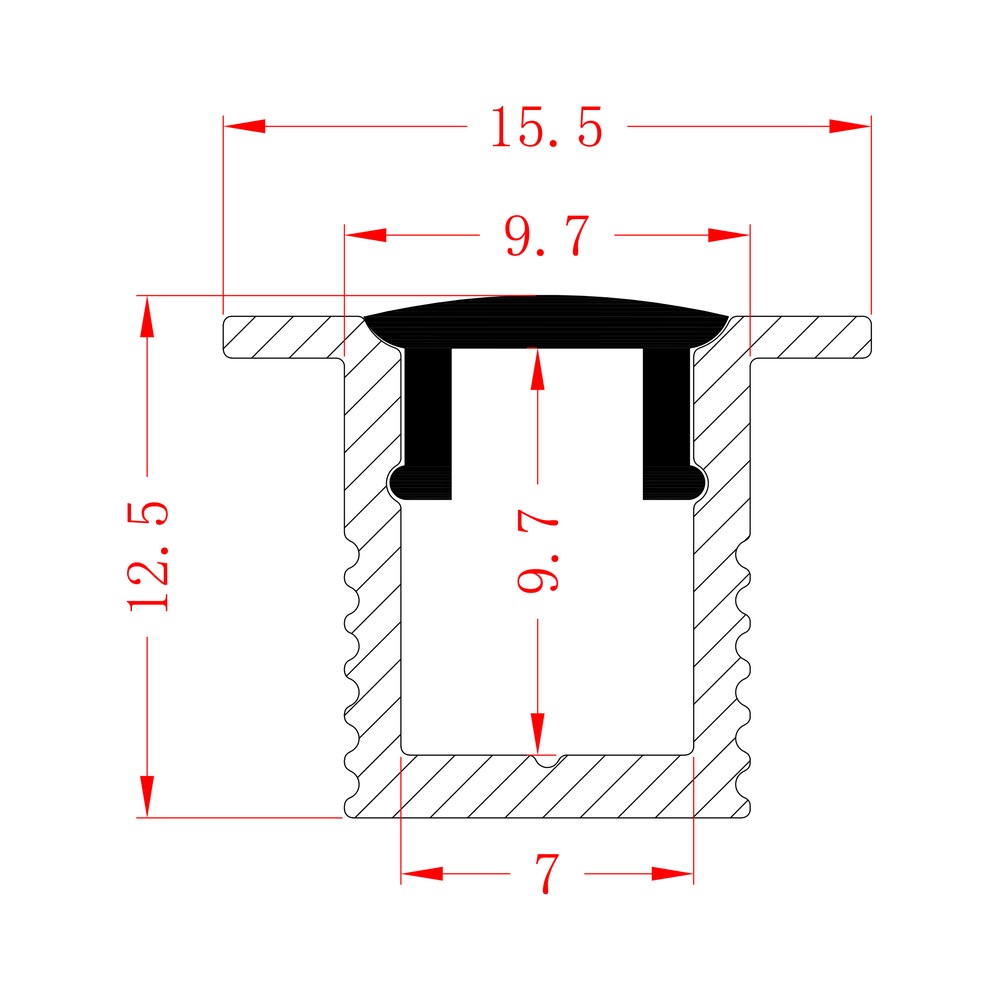
- Tight tolerances are possible. The channel and the cover groove are the two features where this matters.
- Anodizing comes out even. Lower copper content means fewer dull spots in a dyed finish.
What does T5 mean?
T5 describes a heat treatment route, not a strength grade.
The billet is heated to roughly 450–500 °C and pushed through a steel die. As the hot profile leaves the press, it is air-quenched by fans, then cooled to room temperature and artificially aged in an oven at about 175–185 °C for several hours. The aging precipitates magnesium and silicon within the metal, locking in the final mechanical properties.
Two things are notable about that route:
There is no separate solution treatment. That is what distinguishes T5 from T6. The profile is quenched as it leaves the die and aged — one thermal cycle rather than two.
It preserves surface quality. Because the metal is not water-quenched, it does not distort the way T6 can. The face stays flat, which is why cosmetic extrusions are usually T5.
What does the temper change in practice?
Strength and ductility move in opposite directions, and the trade-off matters for a profile.
| Property | 6063-T5 | 6063-T6 |
|---|---|---|
| Yield strength | ~110–145 MPa | ~160 MPa |
| Tensile strength | ~145–186 MPa | ~186–241 MPa |
| Elongation at break | 8–12% | Lower |
| Behaviour when bent | Bends without cracking | Prone to cracking |
| Surface after quenching | Flat, clean | Can show slight distortion |
| Typical use | Architectural, cosmetic, formed parts | Structural, load-bearing |
For an LED profile, the useful reading is not the strength column. It is the bend column.
A profile sometimes has to be curved — an arched ceiling detail, a radiused reveal, a formed corner. T5 bends; T6 tends to crack. That single difference decides the temper for anything that will be formed after extrusion, and it is the reason most stock architectural extrusions ship in T5.
The strength that is given up is rarely needed. An LED profile carries a strip and a diffuser, not a load.
Why can't you tell T5 from a photograph?
You cannot, and this is where most of the confusion in the market comes from.
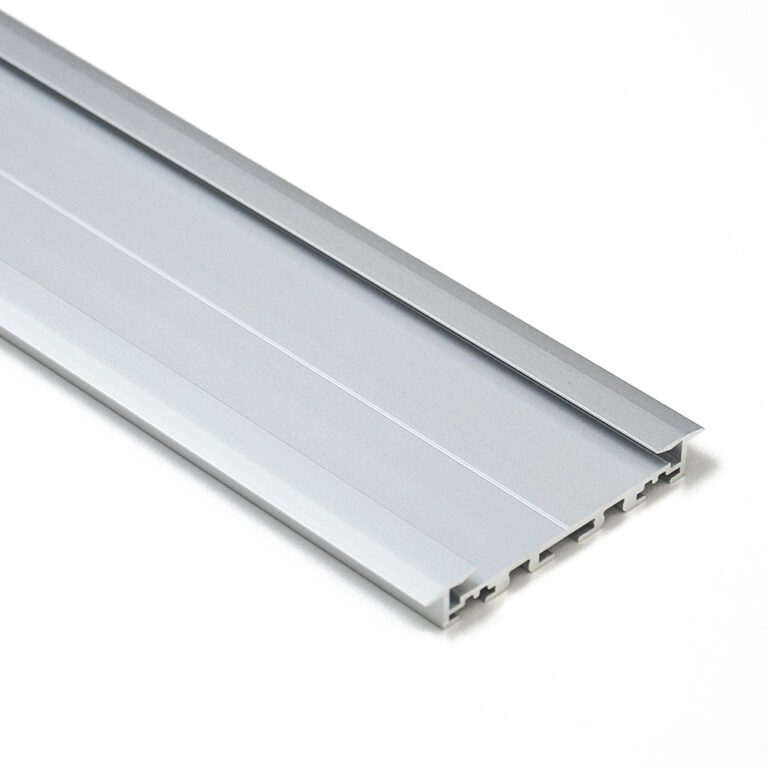
Two profiles photographed side by side look identical whether they are 6063-T5, 6063-T6, a lower grade, or recycled metal with inconsistent properties. Surface finish tells you about the die and the anodizing; it says nothing about the temper.
What actually distinguishes them is not visible:
- Straightness over length. A poorly aged profile can drift after machining, because internal stress was never relieved.
- Behaviour at the cut. A brittle temper chips differently at the blade.
- Anodizing evenness. Inconsistent alloy shows as patchiness in a dyed finish.
- The mill certificate. The only direct evidence.
So "6063-T5" in a quotation is a claim, and the certificate is what makes it a specification.
What should you ask a supplier?
Four questions that produce verifiable answers rather than adjectives:
- What alloy, and is it stated on the mill certificate? "Aluminum" is not an answer.
- What temper, and does the certificate show it? T5 and T6 are different products.
- What wall thickness on the drawing? Thickness is a design decision, not a grade.
- Is any regrind or recycled content used? Recycled aluminum with mixed composition can fall well below the thermal conductivity of virgin 6063, which matters on a heat-sinking part.
The fourth question is the one buyers rarely ask, and it is the one that most affects whether the body performs as the drawing intends.
How is the temper verified on delivery?
Two checks, one documentary and one physical.
The mill certificate. It should name the alloy, the temper, the heat or batch number, and the mechanical properties — typically tensile strength, yield strength and elongation. If it lists only "6063" with no temper line, it is not a T5 certificate; it is a material description.
A straightness check across the batch. Lay several bars on a flat surface and look along them. A profile that was aged correctly holds its line. One that was quenched or aged inconsistently can show a gradual bow, and that bow usually appears after anodizing rather than before — which is why it is worth checking twice.
Two things that are not evidence, though they are often treated as such:
- Surface finish. A smooth face tells you the die was good, and the anodizing was even. It says nothing about temper.
- A number stamped on the bar. Batch and die numbers trace a run; they do not certify a heat treatment.
Where a project has a structural or forming requirement — a radius, an arched detail, a load-bearing fixing — the certificate is the only thing that settles the question. Everything else is a description.
What do we actually supply?
Our specification sheet lists the material as 6063 for all 219 profiles. Thirty-eight of them state the T5 temper explicitly in the material field; the rest are listed as 6063 without a temper callout.
If a project requires T5 on the certificate, say so on the order — it is confirmed against the mill certificate rather than assumed from the catalogue. The distinction matters enough to be written down, and our range lists the material for every model so the specification can be checked before quoting.
Is 6063-T5 strong enough for a suspended profile?
Yes. A suspended body carries its own weight, the strip and the diffuser — a small load for a section with a 110 MPa yield strength. Where a run spans a long distance between suspension points, the limit is stiffness (sag), not strength.
What is the difference between 6063-T5 and 6061-T6?
6061 is a stronger alloy with more magnesium and silicon, and T6 adds a full solution treatment. It is harder, less formable, and finishes less evenly. For load-bearing parts, 6061-T6 is right; for a thin-walled cosmetic extrusion, 6063-T5 extrudes better and anodizes better.
Can a 6063-T5 profile be welded?
Yes, with 4043 or 5356 filler. The weld zone drops toward annealed strength, so a welded joint is mechanically weaker than the extrusion around it — which is why joints are usually mechanical rather than welded.
Does the alloy affect heat dissipation?
It does. 6063 conducts around 200 W/m·K; aluminum with a high recycled content and mixed composition can be noticeably lower. For a heat-sinking body at high output, the alloy is part of the thermal design, not just the structural one.
Why do some listings say "aluminum 6063" and others "6063-T5"?
Because the temper is often left unstated, both may be the same product; only the certificate settles it. When a drawing specifies T5, ask for the certificate line that shows it rather than accepting the catalogue wording.

We design and supply LED aluminum profiles and linear lighting — over 200 profiles with matched diffusers and fittings, serving customers in more than 100 countries since 2007.
Related reading
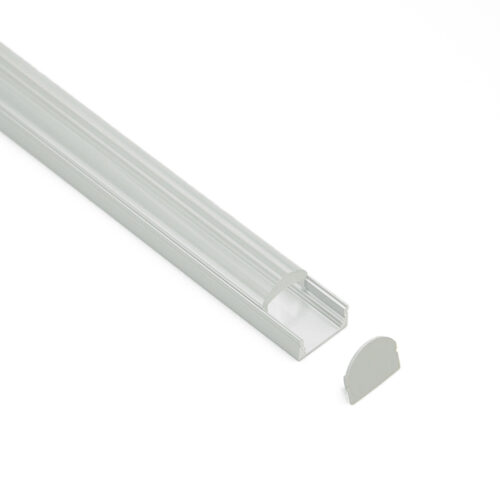


Send the strip width, the run length and the destination — we will match the profile, the diffuser and the fittings, and quote within 1 business day.
Start your inquiry