



How to Mount Profiles on Concrete or Tile
The profile is not the problem — the substrate is. How to fix into concrete, why tile must never take a fixing on its own, and what changes when you recess.
On concrete and tile, the profile is the easy part. Difficulty sits entirely in the substrate. Concrete takes a fixing well but resists cutting. Tile takes neither: a fixing in tile alone will fail, and drilling it is where most damage happens.
What fixes into concrete?
Three methods, each suiting a different situation.
| Method | Holds well in | Watch out for |
|---|---|---|
| Mechanical anchor | Sound concrete | Must reach past render and skim |
| Chemical anchor | Poor or cracked concrete, near edges | Hole has to be cleaned properly |
| Adhesive alone | Flat, sound, light-load surfaces | Not acceptable overhead |
Mechanical anchors: a drilled hole, a plug or anchor, a screw. This is the standard for a soffit or wall, and what a clip is designed for. The anchor must reach sound concrete beyond any render or skim coat. A fixing that grips only plaster holds nothing.
Chemical anchors: a resin capsule or cartridge, used where concrete is poor, where the hole sits close to an edge, or where vibration is expected. Slower to install, and it needs a properly cleaned hole. It holds where a mechanical anchor will not.
Adhesive alone: only where the surface is sound, flat and clean, and the load is light. On a soffit, anything overhead, adhesive alone is wrong, because its failure mode is the run coming down.
Substrate usually picks between mechanical and chemical, not the profile. Test the concrete first. A fixing that spins, or that crumbles the hole, tells you the concrete is not what the drawing assumed.
What about tile?
Tile is a finish, not a substrate. A fixing into tile alone will fail. Tile is brittle, it bonds to something behind it, and nobody designed it to carry a point load.
Three approaches, ordered by reliability.
Fix through the tile into the wall behind. Drill through, use an anchor that reaches the structural substrate, and seal the hole around the fixing. That is the standard detail for a surface-mounted profile on tile.
Fix above or below the tile line. Where design allows, mount the profile on plaster or ceiling, not on tile. This avoids drilling tile entirely, and it is always the better option when possible.
Bond to the tile with an adhesive system designed for it. Acceptable for a light, short run where drilling is not permitted. It depends entirely on sound tile and an adhesive right for the substrate, never a general-purpose construction adhesive.
Two things go wrong when drilling tile. Cracking comes from a hammer-action drill, so use rotary-only with a tile bit. Chipping hits the glaze on the visible face, so drill from the finished side with a slow start. A chipped hole needs a cover plate, or a rethink.
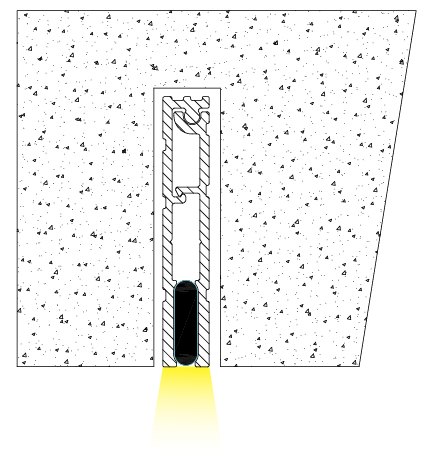
Can a profile be recessed into concrete?
Yes, and it is a different operation from surface mounting.
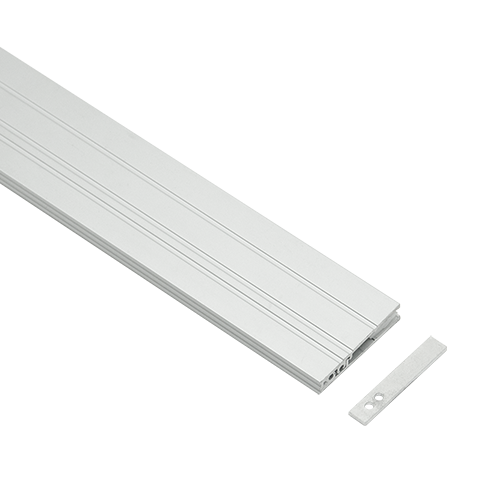
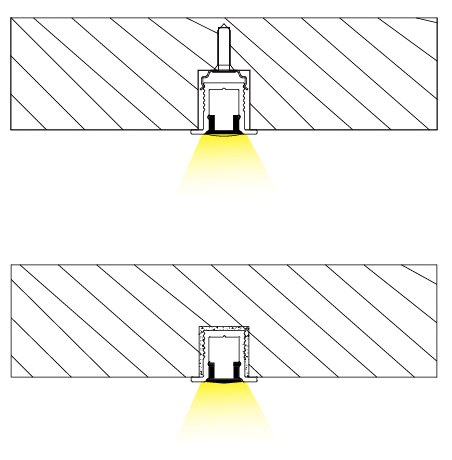
A concrete soffit or wall can be chased, cut with a grinder or wall chaser, to take a shallow body. Our HL-A092 is built for this: 35 mm wide, 6 mm deep, taking a 4 mm strip, and covered with silicone, not a rigid diffuser. Depth makes it viable in a chase. A 6 mm slot in concrete is a manageable cut; a deeper one is not.
Two constraints decide whether this works.
Chase depth against section. A 6 mm body needs a 6 mm chase, plus tolerance. A 12 mm body needs 12 mm. Cutting 12 mm out of a concrete soffit is a far bigger operation, and it may meet reinforcement.
What sits inside the concrete. Reinforcement, conduits, embedded services. A chase that meets rebar stops there, and design has to allow for that. Usually that means keeping the recess shallow, or avoiding it.
Where a chase is not viable, use a surface-mounted body with a shallow section, or a suspended ceiling that creates a void.
What if the surface is uneven?
Concrete is rarely flat, and a cast soffit can vary by more than profile depth over a few meters. Two consequences follow.
A rigid body will not follow the surface. It bears on high points and stands off elsewhere, which shows as a gap along the run and a line that is not straight.
Clips answer this, not screws. A clip with a slotted base takes up variation between fixing points. A screw pulls the body to the surface and transfers the error into the line.
For a long run on an uneven soffit, set a continuous backing rail first. That is a straight member fixed to concrete, with packing where needed, and the profile fixes to it. It adds an operation, and it is the only way to get a straight line on a bad substrate.
What not to do
Four failures that recur.
Fixing into render only. The anchor grips skim, not concrete. It holds until it does not, usually at a bad moment.
Drilling tile with hammer action. It cracks the tile, sometimes the whole field around it.
Using adhesive on a soffit. Overhead adhesive is a single point of failure with heavy consequences.
Assuming a chase will fit. Design draws the chase; site cuts it. What sits inside concrete is known only when the blade meets it, so allow for the recess not happening.
What do you check before you start?
Four things, all before the first hole.
- What is the substrate? Concrete, block, or screed over something else. A test fixing answers this in a minute.
- What sits on top? Render, plaster, tile, paint. The anchor must reach through all of it.
- Is anything embedded? Services, conduits, reinforcement. Drawings help; a detector helps more.
- What load? A 2 m wide-section body is heavier than it looks, and a clip rated for a cabinet section may not carry it.
Our surface-mounted collection covers bodies intended for direct fixing. The full range lists every section, so you can choose a fixing based on body weight.
Can I use double-sided tape on a tiled wall?
For a light, short run on sound tile, it can work. Use tape designed for that load and surface, and only where the tile is not in a wet area. On a soffit, or above a working surface, use a mechanical fixing.
How deep can I chase into concrete?
What sits inside, and the structural role of the surface, set the limit. A shallow chase for a 6 mm body is routine work. Anything deeper needs checking against reinforcement, and against whoever owns the structure. That is not a decision a lighting supplier can make.
Does a concrete soffit need a different profile?
Not a different product, but a different fixing. The section can match plasterboard. What changes is the anchor, and on an uneven surface, the backing rail.
What about an outdoor concrete wall?
Same fixing, different sealing. An outdoor run needs the assembly sealed at both ends, with the cable entry glanded. The profile itself claims no IP rating, because the rating belongs to the assembly.
Can I mount a profile to a concrete ceiling without drilling?
Only with a system designed for it: a proprietary adhesive fixing rated for overhead use, or a suspended arrangement that takes load elsewhere. General construction adhesive is not that system.

We design and supply LED aluminum profiles and linear lighting — over 200 profiles with matched diffusers and fittings, serving customers in more than 100 countries since 2007.
Related reading

Send the strip width, the run length and the destination — we will match the profile, the diffuser and the fittings, and quote within 1 business day.
Start your inquiry